by Felicitas Ritter | Feb 14, 2014 | Advertising, Latest
Over the last several years, we seem to be focusing more and more on reality for our entertainment. From Survivor to The Real Housewives to Big Brother… apparently voyeurism sells very well. The same trend has also been cropping up over the years in advertising.
The Dove campaign for real beauty was highly successful and original when it first launched in 2004. Since then, we’ve seen many more advertisers following suit using people who appear to be appreciating products in real-life (even if in actuality they may be paid actors). Febreze has filmed people smell testing their products in a variety of disgusting situations since 2011. And in 2013, a Pepsi commercial that received a great deal of attention was one created from a test driving prank at a dealership with Jeff Gordon.
Perhaps this new fascination with reality is in part because we are so interconnected
…through the media, Internet, cell phones – whenever anything of significance happens, we hear about it almost instantaneously. And with the rise of social media, people photographing and posting “selfies” with their favourite things is now very commonplace and popular. It’s also putting a shelf-life on our celebrities who may or may not be able to maintain the images they would like too – which may make using “real” people as spokespersons a safer bet in the long-run.
When one of our athletes wins a medal at the Olympics, there’s an app to give us the download. When Justin Bieber is behaving badly, the Internet erupts with the play-by-play. And whenever Toronto Mayor Rob Ford is set to make his next ethical or political blunder, you can be sure we will all have front-row seats to that action. Once an unfortunate incident has reached Twitter or YouTube proportions, “handling” public perception afterward becomes quite difficult – even with a crisis preparedness plan.
Consumers these days are also far more savvy than once upon a time and not as willing to accept things at face value – they want the dirt and are willing to dig for it. Whether that means getting the latest star gossip, uncovering a government scandal, or wanting to know whether everyday products are organic or eco friendly, truth in life and advertising is what everyone is looking for. What this means for marketers is that branding claims – and spokespeople – better hold up to scrutiny, or the likelihood of uncomfortable revelations is good.
by Belinda Lui | Feb 3, 2014 | Advertising, Branding, Business Success, Communications, Creative, Design, Latest, Marketing, Social Media
We’ve been noticing a trend recently that lends a hand to the celebrities and shows that a lot of us grew up watching. What is the purpose of using these particular stars or shows to appeal to viewers? We think it has something to do with nostalgic value. Retro advertising has been done before but ever since Oikos used the stars from Full House to market their products during the Super Bowl, we’ve seen other brands follow suit. Before we share some of these ads with you, let’s discuss why nostalgic value has any value when it comes to retro advertising:
Much like emotive advertising, retro advertising is successful because we associate certain memories and feelings with that time period in our lives. I don’t know about you, but I associate only good things with the TV shows that I grew up watching. I remember coming home from (what seemed like) a never-ending day at school, plopping myself down on the couch with a tall glass of milk, and watching after-school specials until my mother came home. That small window of alone time never went unappreciated. It was an adolescent’s time to reflect on the lessons being taught through these programs. So, when a legacy brand uses a legacy show to simulate certain emotive associations — it’s actually quite a brilliant strategy; especially if that brand is formerly associated with negative feelings.
Retro Advertising at its finest:
This is Delta’s ’80s-themed safety video: a fun and light-hearted take on a video that so many of us choose to ignore before taking off on a flight. Bet you won’t be able to ignore it now!
This is some of the cast from Full House appearing on Jimmy Fallon — this may not be directly advertising a product or service, but it was the top trending viral video on Facebook on January 20, 2014.
What examples of retro advertising can you share with us?
by Belinda Lui | Jan 23, 2014 | Advertising, Latest
When companies spend $4 million on a 30-second spot during the Super Bowl — it only makes sense that they would also present teasers in the weeks leading up to the celebrated event to take place next weekend. The Super Bowl is exciting for football fans but it is equally as exciting for marketers and advertisers alike. Reinforcing the promotion of these advertisements with hashtags such as #fuelyourpleasure for Oikos Greek Yogurt ads featuring some of the cast from the hit-show Full House is only one of the ways that brands are building awareness amongst its community. You can preview some of these Super Bowl teasers on YouTube’s Ad Blitz channel.
Arnold Schwarzenegger was reportedly paid $3 million to appear in Bud Light ads during the Super Bowl. He is among many other celebrities who will make appearances in advertisements this year. While celebrity endorsements is nothing new to the advertising world, it continues to appeal to customers in ways they otherwise might not without them.
Still, Social Media is a major element in the marketing and advertising worlds today — and one method of tracking the success of an advertisement is how often a teaser video was shared, liked, or commented on. Statistics have shown that the engagement levels of Super Bowl ad teasers in 2013 more than doubled that of 2012. Talk about return on investment!
With that said, here are some of our favourite Super Bowl ads this year:
1. Volkswagen
2. Bud Light – with Arnold Schwarzenegger and Don Cheadle
3. Oikos
4. TurboTax
Oikos tapped into viewers’ nostalgia by using John Stamos, Dave Coulier, and Bob Saget as celebrity appearances. All of us who grew up watching Full House can relate to the familial support and greatness that was Uncle Jesse, humorous Uncle Joey, and the single father Danny Tanner. Great choice, Oikos!
What are some of your favourite Super Bowl ads (past or present)?
by Miriam Hara | Jan 19, 2014 | Advertising, Latest
The Olympic Games are quickly approaching and brands are all out there with emotive and sports related advertising . No sooner have we recovered from ringing in the new year and all the holiday season advertising, we are now being served with heart tugging emotive advertising. It goes without saying the Marketers have realized that they don’t need to be an actual Olympic sponsor to jump on the coat tails of the winter Olympic games. Brand Sponsors and non sponsors alike have realized the benefits of not only presenting brands emotively, but offering up a good dose of inspiration.
None has done the job of inspiring and bringing tears to our eyes than P&G, with its Tribute to Moms. To call this creative piece an ad, does not do justice to the concept or intent. This is not an ad: this is a tribute to the dedication and commitment of Moms all over the world. Cross culture. Cross Border. It inspires all, acknowledges all…nothing left to say, but pass the tissue please! (and let’s hope it’s a tissue from P&G!)
However, brands aren’t the only ones capitalizing on emotion and inspiration. Countries and their sports affiliates have fine-tuned the art of emotive advertising to a science.

In Canada, the Canadian Olympic Games association has launched a “We are Winter” initiative that is inspiring as it is culturally in line with Canadian thinking.
With less than a month to go for the 2014 Olympic Games in Sochi, Russia to get here, the Canadian Olympic Games has launched its “We Are Winter” campaign. The Calgary Herald reported that the campaign features two 60-second and four 30-second television spots, as well as one 15-second spot.
On the olympic.ca site, the videos are engaging and beautifully executed, highlighting 17 athletes with their stories and challenges all the while, articulating their competitive sport in very human terms. At once they are emotional, inspiring and dare I say a tad patriotic. Here are a few of them.
Kaillie Humphries
Roz Groenewoud
Denny Morrison
Hope you enjoyed this Canadian inspiration. Let the Olympic Games begin!
by Lindsay Sleightholm | Dec 18, 2013 | Advertising, Latest
As we all know, any retail brand that doesn’t get on board with holiday advertising is missing out. A lagging year of sales can be more than made up for within the last couple of months with a successful holiday campaign.
Since the 1920s, The Coca-Cola Company has been doing just that – and for good reason. The initial strategy was to position Coca-Cola as a year-round refreshment in North America, despite the fact that the drink, best served cold, isn’t what most would reach for during the holidays. The benefit of their strategy is twofold: Get people drinking a cold beverage during the winter, while reaping the rewards of holiday spending.
Today, The Coca-Cola Company is one of the best at emotive advertising during this festive time of year.
But how do they do it so well? Maybe it’s because of the product’s red and white branding that is synonymous with Christmas – the holiday that Coca-Cola primarily focuses their seasonal advertising efforts around. Or maybe it’s because the brand image they’ve built up over the years really focuses on relationships, sharing and happiness – all of the warm and fuzzy feelings that consumers crave this time of year. Or maybe it’s just because they’ve been doing it a little bit longer than most.
Rather than guessing, let’s take a look at some of the holiday advertising efforts from a brand that really knows how to capture our emotions and make the most of this retail season.
Santa Claus
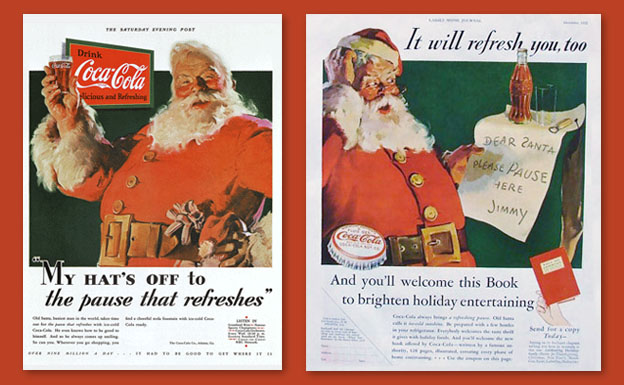
1931 marked the start of the Coca-Cola Christmas advertising campaign that would end up greatly influencing the image of the modern day Santa Claus. It was the interpretation of artist Haddon Sundblom, who was inspired by Clement Clarke Moore’s 1822 poem “‘Twas the Night Before Christmas”, that gave life to the Company’s jolly old Saint Nick. The Coca-Cola Santa could often be seen taking a break from his hectic Christmas schedule to enjoy a bottle of Coke.
 The Polar Bears
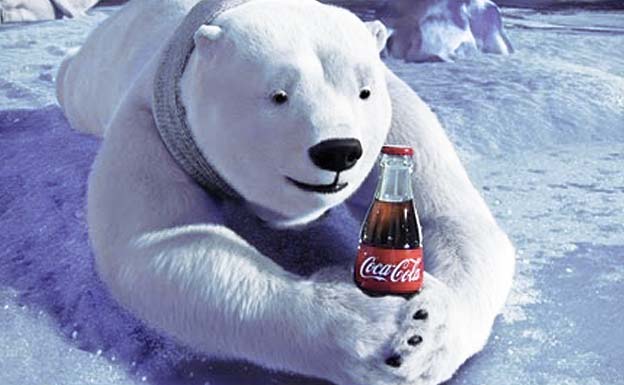
The polar bear image arrived within Coca-Cola advertising in the early part of the 20th century, appearing in print as early as 1922. Although, it wouldn’t be until 1993 that the cuddly white creatures really came to life, during the company’s “Aways Coca-Cola” TV campaign. With help from the vision of creative Ken Stewart, Coca-Cola was able to go one step further with the bears. Thanks to sophisticated computer animation, they were able to portray human-like personalities, while enjoying all the festivities of the Christmas season in the great white north – complete with Coke. “That’s really what we were trying to do – create a character that’s innocent, fun and reflects the best attributes we like to call ‘human,’” said Stewart.
 Holiday Caravan
In 1995, Coca-Cola took their holiday advertising to a truly on-the-ground level when they started rolling out a fleet of extra special delivery trucks, each decked out in Coca-Cola Christmas branding, lit up with hundreds of holiday lights and emblazoned with the phrase, “Holidays are Coming!” What started as a TV campaign now includes a rigorous agenda of actual trucks making stops at hundreds of towns around the world, with the aim of delivering some of the celebration of the season right to the consumer. For many, the trucks have now come to symbolize the official start of the Christmas season.
 After almost a century of making Christmas a top priority in their sales year, Coca-Cola has all-but cornered the market on holiday advertising. But it really doesn’t matter what you’re selling at this time of year. What matters is how you’re able to tap into the emotions of your market during the holidays. Whether you’re toting Christmas, Hanukkah, Kwanzaa or something much more holiday-neutral, what’s important is your approach to the message. If we’ve learned anything from Coca-Cola’s success, it’s that your message needs to be emotive, genuine, empathic, and it needs to appeal to everyone – from the uber-holiday enthusiast to the biggest cynic.
If you can tackle all that, your consumers will pay attention and your bottom line will reap the rewards.
by Miriam Hara | Dec 16, 2013 | Advertising, Latest
It really goes without saying that star power builds awareness. However, utilizing celebrities as part of a brand’s advertising campaign can be a double-edged sword. The more obvious reason is that stars themselves, especially in today’s landscape, are brands in their own right. They aren’t just actors or athletes, they too are responsible for their own brands and propelling it forward. As such, it is difficult for a brand not be eclipsed by the star’s own brand… and to stand apart from the star’s own persona. But it can be done:
No brand utilizes star power as well as Chanel No 5.
Chanel No 5 has always used star power to propel its brand forward; to constantly reinvent itself and to evolve with the times. In fact, star power is at the cornerstone of Chanel No 5’s brand persona. The 2013 ads for Chanel No 5 featuring Brad Pitt were very well thought out. It was a novel approach featuring a man’s perspective on Chanel No 5. With Brad Pitt, Chanel No 5 spoke to women on a totally different level than the ads that featured Nicole Kidman and yes, even Catherine Deneuve (1979 Chanel No 5 ad). Brad Pitt spoke to Chanel No 5’s target – women on a purely fantasy level.
Now, one year later, Chanel No 5 advertising, just in time for the holiday season, features the legendary star Marilyn Monroe. What a beautifully executed, thought-provoking and emotive concept. It speaks to women on so many levels — although I would say with confidence, it equally speaks to men!
From a design and purely conceptual level, the current Marilyn Monroe is no trend, embracing the retro trend. The film footage in black and white is beautiful to look at and the audio track adds nostalgia to the sexy persona that is synonymous with Marilyn Monroe. Highly emotive, the ad playing on every woman’s sexiness. With that one simple testimonial, “I wear Chanel No 5 to bed” unlocks the inner woman in every woman. What woman can’t relate to the idea of this self-indulgent concept, celebrating her independence and self-love!
So kudos to Chanel No 5… Much to my chagrin, I must say, “step aside Brad Pitt!”… after all, Marilyn Monroe provides to women something that Brad can’t offer: a feeling that is easily attainable. All they need to do is wear Chanel No 5 to bed!
