by Joyce Turner-Gionet | Dec 9, 2015 | Branding, Creative, Design, Latest, Marketing
The building of a brand icon
“When Andy Warhol wanted a shape to represent mass culture, he drew the [Coca Cola] bottle and when Volkswagen wanted to celebrate the shape of the Beatle, they compared the car to the bottle.” Excerpt from the Coca Cola Journey™: Celebrating 100 years of the Coca-Cola bottle.
How has the little glass Coke bottle transcended continents, cultures, languages and timelines to remain as firmly rooted in our experience today as when it first appeared 100 years ago? How did it get to be a brand icon? Which begs the question …
How does your packaging stack up to that kind of history? Are you a brand icon in the making?
When you check the retail shelf are you already blowing the dust off that packaging redesign you did last year? Every day we’re exposed to great brands with clever packaging. Some of it is truly inspired, but brand icon? That’s the kind of drawing power only a handful of brands command.
This blog was inspired by 3H Senior Designer Lindsay Sleightholm: “I love Coca-Cola branding. I was drawn to it even before I studied to become a graphic designer. Actually, it might have had a little bit to do with my career decision.”
That’s a big statement, but I’d hazard a guess that like Lindsay, each of us has been touched in some way by the allure of the little glass bottle.
Good Design Takes Things Personally
Lindsay: “For me, it started with a Coca-Cola pub mirror that my parents had hanging on a wall in our house when I was young. The copy read: “5¢, Delicious, Coca-Cola Relieves Fatigue, The Most Refreshing Drink in The World,” with a vintage photo of a young girl from the Edwardian era holding a glass of fountain Coke. No one could get away with those claims anymore (let alone the imagery). But back then I was sold. Not in the messaging so much, but in the feelings it evoked.
Today, I have a collection of Coca-Cola memorabilia: bottles, cans, signs, print ads, even an old cooler, and I still have that mirror. As far as antiques go, I don’t think the mirror holds much monetary value. For me, the value is sentimental.”
A brand moves from great to iconic by tapping into feelings and sentiments that are universal. Coca Cola’s advertising holds up a world mirror, reflecting the good times we’ve experienced with a bottle of Coke in hand, and it promises more good times to come, with a Coke in hand.
Good Design Shakes Things Up
Lindsay: “As with anything in branding and package design, it boils down to being unique. Coca-Cola learned this early on. It wasn’t enough to have a great tasting product because competitors could mimic the formula. What they needed was a way to stand apart from their competition. They accomplished this in 1915 with the contour bottle design — an abrupt departure from every other bottle design at the time. The mandate was for a bottle ‘that could be recognized when broken on the ground or by touch in the dark.‘ The design was originally patented and later trademarked. It’s a design that is ergonomic, iconic and as synonymous with the brand as the logo. You only need to see a silhouette of the bottle to know what the product is.”
Timeline: The Evolution of the Coca-Cola bottle.
See what the competition’s doing and then do it differently. Shake things up.
Good Design Walks the Talk Over Time
Lindsay: “The design of the Coke bottle is timeless because essentially it’s remained the same for 100 years and yet it’s still 100% relevant. There have been modifications over the years to allow the bottle to adapt to changing styles and trends in packaging – not so much the shape of the bottle, although that has evolved — but in the materials used to manufacture it. It was originally glass, then plastic, then aluminum, and now with certain skus there’s a return to glass. The bottle design is a perfect example of adapting to changing market demands while remaining true to a clear vision for the brand. Not to mention, ‘everything old is new again.’ Which in the case of the Coke bottle took 100 years.
Coca-Cola hasn’t drifted too far from the original design, so in essence we’ve all grown up with it. The bottle brings a sense of familiarity and nostalgia to people when they see it. Even if you don’t like the product you can’t help relating to it on some level.”
So what’s the message in the bottle?
So what’s the message in the bottle? Clarify your vision and remain true to it. When you find a design that works don’t mess (too much) with it. Coke says it best, recalling the universal backlash to a formula change in 1985: “The fabled secret formula for Coca-Cola was changed, adopting a formula preferred in taste tests of nearly 200,000 consumers. What these tests didn’t show, of course, was the bond consumers felt with their Coca-Cola — something they didn’t want anyone, including The Coca-Cola Company, tampering with.”
The coke bottle is a beautiful design and it remains relevant. But that’s not always the case. As Miriam, Chief Creative Officer at 3H, blogged, “you have to design within the framework of the culture. Even though it hurts to let a beautiful design go, if it doesn’t perform it will be let go eventually and the costs associated will be significant.”
Thank you Coca-Cola for 100 years of keeping it real and building a true brand icon. You’re an inspiration to all of us. If you haven’t seen Coca-Cola’s Celebrating 100 years of the Coca-Cola bottle, check it out, it’s a fascinating look at the life of a fascinating brand.
Want a few tips on how to get your brand’s message in a bottle, bag, box, or whatever shape you think your packaging will take? Download our free re:design e-book.
by Joyce Turner-Gionet | Nov 20, 2015 | Branding, Creative, Design, Latest
As Visual Identity ambassadors, we examine the marketing data we collect through every filter imaginable; we look at trends and we anticipate shifts. We sort and analyze the information to death and it’s important that we do. What we’re doing is looking for truths, looking for what’s real and what resonates with consumers. But as we’ve said before, if the end result — the product and the packaging — don’t reflect those truths, if our efforts don’t come across as real, then we’re wasting our time and our money.
[dt_sc_pullquote type=”pullquote6″ icon=”no” align=”center”]Good graphic designers know good design when they see it. And they know exactly why it’s good.[/dt_sc_pullquote]
I asked the graphic gurus at 3H to choose their favourite packaging design and speak to why they think it’s great. After all, they spend their days working on visual identity for clients and a big part of that is packaging design. We showcase our work on the 3H website, but sometimes it’s nice to step out and give credit to our colleagues in the great big marketing and advertising pond we’re all swimming in. My point? Good graphic designers know good design when they see it. And they know exactly why it’s good. The rest of us non-designers can learn from this…
Today’s blog is courtesy of Kyle McGuire, Senior Digital Designer at 3H.
[dt_sc_title type=”H3″ border=”Yes” align=”Left”]Kyle’s favourite packaging …[/dt_sc_title]
[dt_sc_two_third first]
Analyzing Visual Identity
Featured Brand: Toronto’s Steam Whistle Pilsner
A Toronto microbrewery started by three “fired guys,” who upon being let go from another Canadian microbrewery opened their own because they wanted to “make a Pilsner that would compete with the best in the world.”
Why Kyle likes it?
Intelligently Simple Creative with a Retro Feel
“It’s a very retro, yet clean logo. It’s a visual identity that stands out from the crowd.
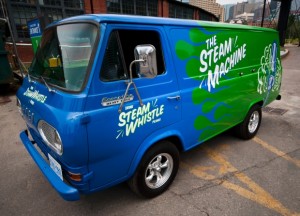
The creative is intelligently simple and always graphically on track with the other pieces in the product line via its clean lines, bold colours, and the consistent retro look. It’s a fun, light-hearted brand and the packaging reflects this, whether we’re talking about the company’s retro van, a 1967 Ford Econoline Heavy Duty that along with an entire fleet of vintage vehicles delivers beer and travels to events around the country, or the clean action of the steam trails in the company logo.
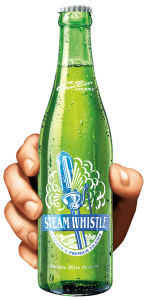
The retro look makes this brand easily identifiable on the shelf, in particular the bright green base colour that is used on everything, including the green bottle, rather than the industry-standard brown bottle. The green bottle is a great retro element, based on vintage bottles from the 1940s and ‘50s.
Smart Packaging
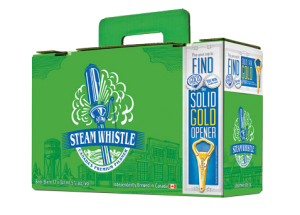
The company calls their packaging “overbuilt.” It is. Steam Whistle redesigned the 12-bottle carrying case; theirs is known as the “suitcase” 12 pack. It has a retractable handle and the top seals itself without the use of glue. It’s an ingenious innovation using die-cutting. The design is also forward thinking because for so long no one changed the format of the 12-pack of beer. It was always a 4 x 3 bottle arrangement with side holes for handles. The “suitcase” is a 2 x 6 pattern and the handle comes straight out of the center of the box so it’s an easy one-handed carry, not prone to tearing.
[/dt_sc_two_third]
[dt_sc_one_third last]
[/dt_sc_one_third]
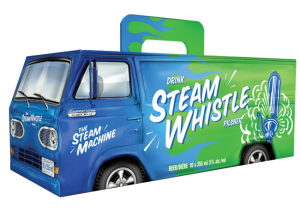
Packaging for the Can Van 10-pack box, inspired by the Steam Whistle Van, is fun, exciting and humorous; it instantly catches your eye on shelf, relying on that vintage look, but with modern packaging development. The perforated rear van doors on the Can Van box open just like the van doors on the back of the Steam Whistle van. This makes it easy to store in the fridge. The Can Van box also uses the same handle as the suitcase, so it’s also easy to carry with one hand without worrying about the handle breaking.
Forward Thinking
Steam Whistle has a very forward thinking approach to its visual identity, both in its package development and graphic design. In my eyes, this synergy makes them one of the most creative companies in package design and development. Their light-hearted, feel-good approach to design consistently comes over as real.
Want a few tips on design or redesign? Download our free re:design e-book.
by Joyce Turner-Gionet | Nov 13, 2015 | Content, Latest, Social Media
Does your marketing message or social media share need to go viral to be effective? How much momentum needs to be behind it?
Viral Marketing; we see it fairly regularly — content goes “viral”. It captures people’s imagination and spreads rapidly. Sometimes it continues to spread long after it’s posted, even years after. If your content’s still being shared months and even years later it says a lot about your content’s relevancy.
“Viral” was a buzzword that appeared in the late 90s. It’s still a buzzword (although I’ve seen more than one post lamenting the overuse of buzzwords, including this one.) Let’s put the term in context. All content you send out through social networks is considered viral if it’s shared. You want content to be contagious. That’s the point. You want people to re-share it. That way your exposure grows exponentially. We all hope for viewing and sharing responses that send our brand soaring into the elite social stratosphere, but that’s rare atmosphere, on a scale that few posts achieve.
A little background on viral marketing
The emergence of “viral marketing” as an approach to advertisement, has been tied to the popularization of the notion that ideas spread like viruses. The field that developed around this notion, memetics, peaked in popularity in the 1990s.[7] As this then began to influence marketing gurus, it took on a life of its own in that new context.
That was years ago and still no one really knows for sure which content will “go viral”. But the common thread contained in all truly viral marketing is that it strikes a chord with people, sometimes universally.
Does the content you’re sharing need to go viral?
Here’s the kernel in this post — does the content you’re sharing need to “go viral”? It does only in the sense that you need to reach the people you want to reach while at the same time extending your reach in order to grow your business and promote your brand. If your content goes crazy, then fantastic, it means massive exposure for your brand. Well done. Rejoice. But your main objective should be to reach your current customers and expand your reach by attracting new customers. And you need to keep all of those people coming back to you for more.
Viral is as viral does. Who are you trying to reach? Are you reaching them? What’s your ultimate objective for your viral marketing? Are you achieving it? You need your message to go viral on a scale that meets your objective? You don’t need to reach the entire universe, you need to reach your universe. Having said that, there’s still lots we can learn from content that goes viral. There are takeaways for all of us in that success. What went viral in 2015? Here’s a post from AdWeek …
Being in the right place is also important to your viral marketing success. Where do the people you want to reach hang out? Are you there with them? Check out this recent post from Social Media Today …
The World’s 21 Most Important Social Media Sites and Apps in 2015.
by Miriam Hara | Nov 10, 2015 | Agency, Business Success, Creative, Latest
Clients who are involved in the client agency relationship do not realize that they have a direct impact on the creative their agency produces. We hear so much about agencies and their creative prowess and how ‘the creative’ talent establishes its reputation. But there’s hardly any mention of the trust factor and how that directly impacts the creative output. The creative process, whether it’s for personal endeavours or professional ones is always based on the ability of the creative mind to be at ease. To feel comfortable in the exploration of the obvious and not so obvious.
There are so many articles and blogs written on brainstorming practices… in group settings or solo ones, but very few tap into the premise of the brainstorming. In order to brainstorm you need a mandate – again, it could be a personal mandate or a professional one, brought forth from a client. If the client fosters the creative team with not only information, but with a sense of team and with a sense of knowledge that the outcome will be nothing short of awesome, then that is a setting for success, for all parties. I have the pleasure of working with clients whom have fostered that environment within our creative team. After the creative process, it’s a delight when we present and the client gets excited and says, “Wow, I wasn’t expecting that”.
Developing creative is an exciting and passionate business to be in. Fostering trust in a business relationship, is the cornerstone of creating creative that wins.
As with any relationship, creating and building on trust is a two-way street. Here’s a few points from both perspectives for the professional relationships:
The Creative Agency Built on Trust:
Know the brief. Ask questions. In order to evolve a brief into a sparkling, unique, rare but concise creative, you need to get involved… and that means that you need to admit that you don’t know. Clients will respect that and this will showcase the intelligence driving the creative outcome.
Empower your client. Never assume that the client doesn’t have a creative bone in their body. Clients know their business better than anyone else, including you. Within their brief, they will articulate gems of creative ideas… and they don’t even realize it. Take those gems and work them into creative that expresses their ideas. They will recognize them as such, and realize that, yes, you really do listen.
Always deliver and more. If a client has asked you to be at the table and provided you with a brief, it’s not only to fulfill the order, it’s to add value to the creative process in order to provide a creative outcome that sings. The damage of over promising and under delivering will break all trust and will start eroding the credibility that has been established. Just because you’re in the business of creating doesn’t mean it’s acceptable to be flighty and irresponsible.
The Client Built on Trust:
Share the knowledge. The more the creative agency knows, the better they are at creating and developing creative that is thought provoking and on target. Understanding the market and the intricate details of the industry is key to creating creative that will push the envelope.
Advocacy is key. Give credit where credit is due… and not to the creative agency, but to the management team. It’s important for the upper layer of management to know that the partner at the table is an instrumental element to the team.
Garner stability. There’s nothing more hurtful to a relationship based on trust than asking the creative agency to continuously fight for the business, especially if they have met 100% of your expectations. Asking a creative agency to continuously have to prove their right to be at the table, is a short term vision of what should be a long term relationship.
by Miriam Hara | Oct 30, 2015 | Content, Interactive, Latest, Social Media
Have brands achieved brand trust through their social media communities? Is the race over?
It seems that we only blinked, but most of us in marketing can now say social media as a platform has been around for a considerable time. Over the last decade if not longer, brands have actively participated in the race to gain social media brand trust with their communities and ultimately their customers. The ever-changing demands to “get it right” have not only propelled the creation of new specialist areas within marketing departments, they’ve created a ‘pioneer ship’ for business in general.
This begs the question whether brands have achieved brand trust through their social media communities. Is the race over? Are brands there yet?
There is no quick and easy answer and the jury is still out. Brands are now more familiar with how to use social media, although not all have acquired the fine distinction of leveraging it. We’ve gone from digital ad campaigns to blogging, to content creation, and visual communications like vlogging — all in the realm of social media. But have we achieved brand trust?
In many boardrooms the underlying concern with any campaign or communication initiative is how to leverage the social media platform. I question whether this is the right question. Isn’t the basis of social media, in its pure context, a platform to develop relationships? Aren’t all relationships built on the aspect of trust? It seems that the term “leverage” implies quite the opposite. Are we looking for leverage or are we building brand trust?
Brand trust through social media is not easy to attain.
In the 90s, marketing departments were touting that consumers were savvier than the 60s, and 70s, and 80s. Now, consumers are not only savvier, but also more demanding of brand personality traits that were at best an image-association in the past.
The delight and wonderment of instant gratification and knowledge has now turned into entitlement. Consumers expect knowledge and information instantly. There are millions of domain sites ready to fulfill that expectation. The Internet has made it so.
What the Internet has also enabled, more so through the social media platform, is niche marketing. Just as consumers have virtually millions of sites at their physical fingertips, marketers and businesses have masses of niche marketing channels to choose from.
As with any great opportunity comes some risk. Developing brand trust through digital niche initiatives takes skill. In order for brands to develop social media trust, marketers must acknowledge that there are real and present pitfalls and realities in developing brand trust:
Be True
If you can’t be honest and true, even at times at the expense of your brand (and how risky is that?), you can’t build social media trust for your brand. Social media trust is only built by the perception of its community. In order to achieve greatness in the eyes of the community you must be perceived as impartial — providing value and knowledge without any ulterior motive and without expectation of return.
Brand Karma (You’re so vain)
Some people just walk into a room and people naturally gravitate toward them. Some people try to be vivacious and exciting and fail. The same thing applies for brands. Some brands have it, some brands don’t. That’s what I call brand karma, something a brand naturally has and exploits. The reality is that no one wants to be with a wannabe. They want to be in with the “it” crowd, the ones that define what the “it” is all about.
Mediocrity Sucks
Average means you’re the best of the worst and the worst of the best. Who wants to be associated with that? In today’s fast-paced environment people want the best, the greatest, the most fabulous information on what to do, what not to do, and how to get it. Offer that and your brand will be well on its way to building the brand trust it deserves and wants so badly.
Make a Stand
What is your brand about? What isn’t it about? Place a stake in the sandbox that is on the virtual beach and preach it — day in and day out. You don’t need to be Sally Field (does any one remember Sally Field’s infamous acceptance speech?). It really doesn’t matter if not everyone likes your brand. It matters that the community you seek loves your brand. That’s an important distinction.
You want it when?
Throw out the 3-year plan, or even the 5-year plan for that matter. There is no time agenda for achieving the brand trust factor. It’s ironic that in such a fast-paced environment achieving social media trust for brands is a painstakingly slow process. Building brand trust has always been about consistent messaging. The situational aspects may change, but the context and the ‘how to build’ it and alas, lose it, are very similar.
So, marketers and social media gurus, are some brands already ‘there’? Has anyone achieved brand trust through their social media What do you think?
#SharedWisdom
by Miriam Hara | Oct 29, 2015 | Advertising, Content, Latest, Social Media
If you think social media is about selling, think again.
If you think social media is about selling, think again. Advertising is about selling. Social media is about sharing: sharing your expertise by positioning yourself or your business as the expert. After all, you are the expert, right? As the expert, your role is to share your expertise. A little social media 101 for those still trying to sell instead of share.
Substitute your own product or service in the following example and the thoughts still hold water.
You’re on social media to make people happy. Your ongoing presence on social media should be designed to keep them happy.
Just for a moment, imagine your business as one that sells kitchen knives. You’re not on social media to sell those knives. You do that through your advertising. You’re there to speak to the importance of having the right knife for the job. You’re there to teach people about knives and respond to their questions or comments about your company and its knives. You’re making connections and carving out conversations through your knives.
Kitchen knives come in a variety of styles and each is designed to perform different tasks in the kitchen. So, talk. Talk about knife blades, handles, edges and blade materials that work best for various jobs. Talk about the importance of keeping a knife sharp. Talk about the history of knives. Develop interesting associations with other subjects through your knives. The list is virtually endless and there are endless ways to talk about it all. Think creatively. But keep in mind that social media is a forum for conversation, for imparting information that will teach people something or help them in some way. Give people something to think about. Get them talking. You’re on social media to make people happy. Your ongoing (consistent) presence on social media should be designed to keep them happy. Make sure that they want to keep coming back to hear what else you have to say.
Be creative. Be original. Be funny, if you wish. Don’t take yourself too seriously.
Allow your social media content to spread its wings. Dream up unique ways to present and share information about your company and its products or services. You’re the expert — you own the valuable ‘insider’ information. You know things about your product or service that nobody outside of your company knows. So, share. Use video. Stream video. Show and tell. Show people having fun with your products — make your content a social event. And don’t forget to have fun while you’re doing this (you probably raised your eyebrows at that comment). But if you enjoyed creating the content, then it’s almost certain that your enjoyment will be reflected in your post. Don’t shy away from ‘funny’. Social media has an incredible sense of humour. Be creative. Be original. Be funny, if you wish. Don’t take yourself too seriously.
You might be saying, “Miriam, not all businesses are fun. Mine’s quite a serious business.” I understand. Some of you are in businesses or organizations that require a great deal of tact and diplomacy. But all businesses have a human connection. To be successful that’s what you must reveal on social media — the heart of your business. Share your heart. That’s what social media is about.
Bottom line: If you believe in your business or organization then you’ll have lots to share.
This post underscores the difference between sharing and selling. Bottom line: If you believe in your business or organization then you’ll have lots to share. The beautiful thing about this very social forum is that it’s accessible to all of us and it’s affordable.
So you’re a small company that lacks the budget to compete with the big guns. In social media that doesn’t matter. You don’t have to compete. You’ve (hopefully) identified your niche; now expand it, solidify it, and secure it. Create a following. Extend your reach. Build brand loyalty. Social media is not governed by borders. Want to stretch your content’s wings internationally? Social media is the passport that allows you to travel anywhere, even on a small budget.
… you’re delivering value. And people everywhere love value.
Through well-written content that is varied, interesting and engaging, you’re delivering value. And people everywhere love value.
What else adds value? Sharing different content, on different platforms, via different formats, while staying true to your brand’s culture across platforms — that’s valuable.
Do it right. Position yourself or your business as the expert. Share. Give. Respond. Reveal the heart of your business and people will seek you out.
We learned it in kindergarten: People don’t like people who don’t share.
If you’re not feeling particularly creative or confident about your social media efforts then reach out to someone who can help you develop a strategy; one that leaves room for your efforts to evolve over time. As the world’s most successful brands will tell you, the long-term payback of sharing over selling is worth the effort. If you’re going to be successful, a presence on social media is no longer a choice and sharing is a necessity. We learned it in kindergarten: People don’t like people who don’t share.
Want a few tips on creating content for social media? Download our content creation ebook, ‘Content Creation Understood.’
‘Stop Selling. Start Sharing. It’s what social media is all about.‘ was first edited and published by Social Media Today, on October 15, 2015.