by Lindsay Sleightholm | Dec 18, 2013 | Advertising, Latest
As we all know, any retail brand that doesn’t get on board with holiday advertising is missing out. A lagging year of sales can be more than made up for within the last couple of months with a successful holiday campaign.
Since the 1920s, The Coca-Cola Company has been doing just that – and for good reason. The initial strategy was to position Coca-Cola as a year-round refreshment in North America, despite the fact that the drink, best served cold, isn’t what most would reach for during the holidays. The benefit of their strategy is twofold: Get people drinking a cold beverage during the winter, while reaping the rewards of holiday spending.
Today, The Coca-Cola Company is one of the best at emotive advertising during this festive time of year.
But how do they do it so well? Maybe it’s because of the product’s red and white branding that is synonymous with Christmas – the holiday that Coca-Cola primarily focuses their seasonal advertising efforts around. Or maybe it’s because the brand image they’ve built up over the years really focuses on relationships, sharing and happiness – all of the warm and fuzzy feelings that consumers crave this time of year. Or maybe it’s just because they’ve been doing it a little bit longer than most.
Rather than guessing, let’s take a look at some of the holiday advertising efforts from a brand that really knows how to capture our emotions and make the most of this retail season.
Santa Claus
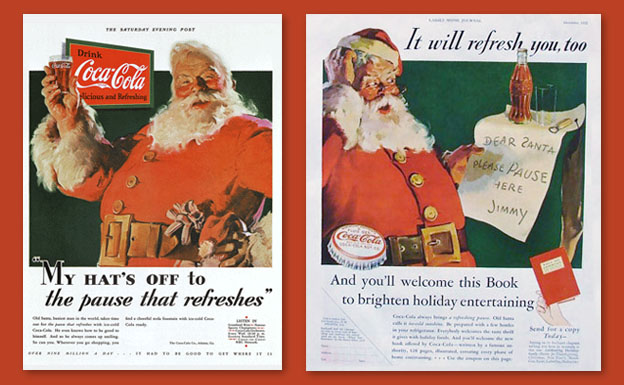
1931 marked the start of the Coca-Cola Christmas advertising campaign that would end up greatly influencing the image of the modern day Santa Claus. It was the interpretation of artist Haddon Sundblom, who was inspired by Clement Clarke Moore’s 1822 poem “‘Twas the Night Before Christmas”, that gave life to the Company’s jolly old Saint Nick. The Coca-Cola Santa could often be seen taking a break from his hectic Christmas schedule to enjoy a bottle of Coke.
 The Polar Bears
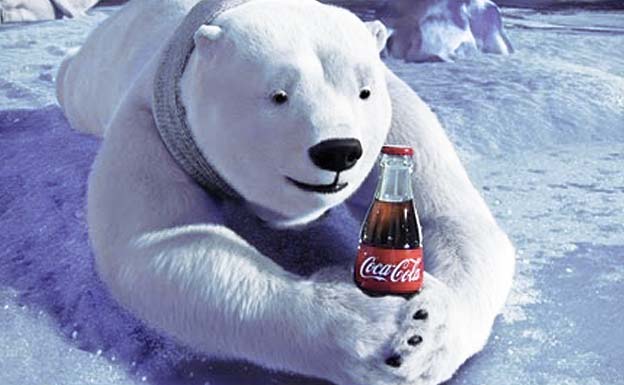
The polar bear image arrived within Coca-Cola advertising in the early part of the 20th century, appearing in print as early as 1922. Although, it wouldn’t be until 1993 that the cuddly white creatures really came to life, during the company’s “Aways Coca-Cola” TV campaign. With help from the vision of creative Ken Stewart, Coca-Cola was able to go one step further with the bears. Thanks to sophisticated computer animation, they were able to portray human-like personalities, while enjoying all the festivities of the Christmas season in the great white north – complete with Coke. “That’s really what we were trying to do – create a character that’s innocent, fun and reflects the best attributes we like to call ‘human,’” said Stewart.
 Holiday Caravan
In 1995, Coca-Cola took their holiday advertising to a truly on-the-ground level when they started rolling out a fleet of extra special delivery trucks, each decked out in Coca-Cola Christmas branding, lit up with hundreds of holiday lights and emblazoned with the phrase, “Holidays are Coming!” What started as a TV campaign now includes a rigorous agenda of actual trucks making stops at hundreds of towns around the world, with the aim of delivering some of the celebration of the season right to the consumer. For many, the trucks have now come to symbolize the official start of the Christmas season.
 After almost a century of making Christmas a top priority in their sales year, Coca-Cola has all-but cornered the market on holiday advertising. But it really doesn’t matter what you’re selling at this time of year. What matters is how you’re able to tap into the emotions of your market during the holidays. Whether you’re toting Christmas, Hanukkah, Kwanzaa or something much more holiday-neutral, what’s important is your approach to the message. If we’ve learned anything from Coca-Cola’s success, it’s that your message needs to be emotive, genuine, empathic, and it needs to appeal to everyone – from the uber-holiday enthusiast to the biggest cynic.
If you can tackle all that, your consumers will pay attention and your bottom line will reap the rewards.
by Miriam Hara | Dec 16, 2013 | Advertising, Latest
It really goes without saying that star power builds awareness. However, utilizing celebrities as part of a brand’s advertising campaign can be a double-edged sword. The more obvious reason is that stars themselves, especially in today’s landscape, are brands in their own right. They aren’t just actors or athletes, they too are responsible for their own brands and propelling it forward. As such, it is difficult for a brand not be eclipsed by the star’s own brand… and to stand apart from the star’s own persona. But it can be done:
No brand utilizes star power as well as Chanel No 5.
Chanel No 5 has always used star power to propel its brand forward; to constantly reinvent itself and to evolve with the times. In fact, star power is at the cornerstone of Chanel No 5’s brand persona. The 2013 ads for Chanel No 5 featuring Brad Pitt were very well thought out. It was a novel approach featuring a man’s perspective on Chanel No 5. With Brad Pitt, Chanel No 5 spoke to women on a totally different level than the ads that featured Nicole Kidman and yes, even Catherine Deneuve (1979 Chanel No 5 ad). Brad Pitt spoke to Chanel No 5’s target – women on a purely fantasy level.
Now, one year later, Chanel No 5 advertising, just in time for the holiday season, features the legendary star Marilyn Monroe. What a beautifully executed, thought-provoking and emotive concept. It speaks to women on so many levels — although I would say with confidence, it equally speaks to men!
From a design and purely conceptual level, the current Marilyn Monroe is no trend, embracing the retro trend. The film footage in black and white is beautiful to look at and the audio track adds nostalgia to the sexy persona that is synonymous with Marilyn Monroe. Highly emotive, the ad playing on every woman’s sexiness. With that one simple testimonial, “I wear Chanel No 5 to bed” unlocks the inner woman in every woman. What woman can’t relate to the idea of this self-indulgent concept, celebrating her independence and self-love!
So kudos to Chanel No 5… Much to my chagrin, I must say, “step aside Brad Pitt!”… after all, Marilyn Monroe provides to women something that Brad can’t offer: a feeling that is easily attainable. All they need to do is wear Chanel No 5 to bed!
by Belinda Lui | Dec 10, 2013 | Latest, Social Media
Social media is an ever-changing world; keeping up with the trends and statistics can be a full-time job on its own. I’ve compiled a list of interesting facts that may help you design a more strategic marketing plan on Twitter: ten tips that will optimize engagement, reach, and your online presence. A lot of what we thought we knew about Twitter has very well changed in 2013. For example, the fastest growing demographic on Twitter is the 55-64 age bracket. That’s not all, though.
Here is a list of 7 statistics that will help you optimize engagement on Twitter:
1. Twitter engagement for brands is 17% higher on weekends
I guess not many people know about this one, because only 19% of brands tweet on the weekends. If you’re trying to encourage your followers to engage with you on Twitter but you don’t want to work over the weekend, you could use the Buffer app to schedule tweets to be sent while you’re having a sleep-in.
2. Tweets with image links get 2x the engagement rate of those without
Just like on Facebook, photos are more engaging for Twitter users.
3. Tweets with less than 100 characters get 17% more engagement
This is another stat that was similar for Facebook. Shorter posts tend to garner more engagement on both platforms. If you’re posting tweets with links, Dan Zarrella’s research shows that 120–130 characters will be your sweet spot.
4. Twitter’s fastest growing demographic is 55-64 year-olds
If you’re looking at growing your audience, you might want to look at new Twitter users, which are most likely in the older age brackets. As Twitter’s user base grows, you’ll have a wider variety of users to target, supposing they’re all part of your market.
5. Tweets with hashtags get 2x more engagement
Having said that, keep the hashtags to a minimum. 1 or 2 will get you 21% more engagement than if you add 3 or more. This could be because hashtags often connect a tweet to a particular topic or Twitter chat that others are following or interested in. Keep appropriate hashtags in mind when posting, especially if engagement is something you’re looking to improve.
6. Twitter users who mostly use a mobile device are 181% more likely to be on Twitter during their commute
When you’re tweeting, think about where your audience is, and what they might be doing. If it’s early in the morning, they might be commuting to the office–this is actually a great time to get them, as they’re probably bored and looking for something interesting to occupy them during this time.
7. Tweets that include links are 86% more likely to be retweeted
Like photos, links appeal to Twitter users. Links, however, are more likely to increase your number of retweets than engagement rate. This is helpful to keep in mind, as you might want to broaden your reach (get more retweets) rather than engage your current followers (increase engagement with photos).
(Information from Buffer)
What are some of your tips on optimizing engagement on Twitter?
by Belinda Lui | Dec 6, 2013 | Advertising, Latest
I took a few courses at Seneca @ York University in Creative Advertising before pursuing a degree in Communications, and my favourite project while I was there was to create an ad for Social Responsibility. Without a pre-existing ad, my group designed copy and creative for Miller Genuine Draft. The 6 teams in my class would be able to present their pitches to my professor, and the winning team would be able to present the pitch to the actual company (with a possibility of being chosen). My team won — but it wasn’t the most rewarding part of the project: cause advertising that encourages social responsibility was. The concept was to encourage taking public transit after having a few drinks and the hope was to appeal to the emotions of people who have lost loved ones to drinking and driving.
In every industry, no matter the product or service, we have a part to play in raising awareness for social responsibility.
Here are a few of my favourite campaigns for social responsibility:
1. Coca-cola – Arctic Home
Raising awareness of climate change and how it’s affecting our Polar Bears.
2. Telus – Habitat for Humanity
Encouraging ‘community’ and helping each other build a better world.
3. Dove – Real Beauty
The vast differences between the way we see ourselves and the way others see us.
4. Red Cross – When You Give, We Give
Helping families rebuild their homes and lives after they have been struck with disaster.
5. Levi’s – Go Forth
A Campaign that encourages every individual to be the change they wish to see in the world.
For an ad campaign to be considered socially responsible, the advertising used in the campaign must meet an ethical standard. Corporate social responsibility marketing has been a focus of several major ad campaigns, but if the ads used in the campaign are seen as deceptive by the public, the company is unlikely to be considered socially responsible regardless of the theme of the advertisements.
What are some of your favourite social responsibility campaigns?
by Belinda Lui | Dec 5, 2013 | Latest, Management
Ever wonder what makes Google the holy grail of productivity and creativity? There’s no magic in the drinking water at the Mountain View, CA company. The tech giant draws from what Google’s chief social evangelist, Gopi Kallayil, calls the nine core principles of innovation.
Kallayil shared his insights at this week’s San Francisco Dreamforce summit.
Here are the nine rules that any enterprise, large or small, can adopt to steal Google’s culture on innovation.
1. INNOVATION COMES FROM ANYWHERE
A medical doctor on Google’s staff argued persuasively that Google had a moral obligation to extend help to those typing searches under the phrase “how to commit suicide.” He ignited the charge to adjust the search engine’s response so that the top of the screen reveals the toll free phone number for the National Suicide Prevention Hotline. The call volume went up by nine percent soon thereafter. The same change has been adopted in many other countries.
2. FOCUS ON THE USER.
Worry about the money later, when you focus on the user, all else will follow. Google improved the speed of its search capabilities with predictive analysis so search suggestions come up after the user types a few keystrokes. This Instant Search feature saves the user a few microseconds with each entry. Google sales reps were concerned that this shortened the time customers would view ads, but the company went ahead and believed that it was worth the risk.
End result? Thanks to Instant Search, Google estimates the time saved is equivalent to giving back mankind 5,000 years after a year of collective use. “Create a great user experience and the revenue will take care of itself,” says Kallayil. In addition, more customers will be attracted to your product’s increased benefits.
3. AIM TO BE TEN TIMES BETTER
If you come into work thinking that you will improve things by ten percent, you will only see incremental change. If you want radical and revolutionary innovation, think 10 times improvement, and that will force you to think outside the box.
4. BET ON TECHNICAL INSIGHTS
Every organization has unique insights, and if you bet on it, it leads to major innovation. Google engineers, not the auto industry, came up with the idea of driverless cars after seeing that millions of traffic deaths come from human error. Working with an artificial intelligence team at Stanford University, Google engineers have produced experimental cars that now have travelled to Lake Tahoe and back to the Bay Area and have given the blind more independence by driving them to shop and carry out errands.
5. SHIP AND ITERATE
Ship your products often and early, and do not wait for perfection. Let users help you to “iterate” it. When Chrome was launched in 2008, every six weeks Google pushed out an improved version. “Today, using that approach, Chrome is the Number One browser in many countries,” says Kallayil, “You may not have perfection in your product, but trust that your users will get back to you.”
6. GIVE EMPLOYEES 20 PERCENT TIME
Give employees 20 percent of their work time to pursue projects they are passionate about, even if it is outside the core job or core mission of the company. “They will delight you with their creative thinking,” Kallayil promises.
7. DEFAULT TO OPEN PROCESSES
Make your processes open to all users. When Google created the Android platform, it knew it could not hire all the best developers on the planet. For that reason, it “defaulted to open,” and encouraged developers outside of Google to create apps for the one billion people using Android devices daily. “That is how an ecosystem is formed,” says Kallayil. In marketing, Google asked users how they would market its voice search app, and children sent clever videos that rivaled the campaigns of the big ad agencies.
8. FAIL WELL
There should be no stigma attached to failure. If you do not fail often, you are not trying hard enough. At Google, once a product fails to reach its potential, it is axed, but the company pulls from the best of the features. “Failure is actually a badge of honor,” he says. “Failure is the way to be innovative and successful. You can fail with pride.”
9. HAVE A MISSION THAT MATTERS
“This is the most important principle,” Kallayil says. “Everyone at Google has a strong sense of mission and purpose. We believe the work we do has impact on millions of people in a positive way.” Each person should have his or her own story.
(Information taken from: Fast Company)