by Joyce Turner-Gionet | Aug 24, 2015 | Business Success, Content, Interactive, Latest, Social Media
Chat slang is no longer just about the kids; it’s not even about the rest of us ‘getting down with the kids.’ It hasn’t been for quite a while!
Hard to believe, but texting has been around for 23 years
The first text message was sent in 1992 by a 22-year-old test engineer from his PC to the Vodaphone network in the US. Chat slang — the ubiquitous LOLs, TTYLs and JKs — now wraps its saucy paws around many of the 350 billion global text (SMS) messages we send monthly. According to the stats, more than 15% of those messages are in a business context.
When it comes to chat slang, we make it up as we go
Almost every text we send has the potential in it somewhere for abbreviation and/or acronym. My mum (in her eighties) has taken to chat slang like the proverbial duck to water. She signs her texts (even Christmas and birthday cards) YFM (Your Favourite Mother; not that I have another mother, LOL). She wanted a picture of my daughter, a nurse, in her hospital scrubs and sent her a text that said: “Can u take a selfie?” (aka a photograph of self).
My daughters rarely answer their phone, but they respond to text and pepper their responses with emojis. My old high school pal regularly texts just one word to me: “Chat?” She doesn’t mean shall we pick up the phone and have a conversation. She means is it a good time to have an extended catch-up session, via text? If I say: “sorry, not now,” she’ll reply: kk 2moro TTYL. A successful chartered accountant who runs her own company, she’s one smart cookie, but texting brings out her impish, casual side.
Whether — as many continue to despair — we’re killing the English language with chat slang, is a moot point. WCYD?
That’s what chat slang is: casual speak. And it is impish. Admit it! As grown ups, the impish aspect can be fun. The abbreviation of words and phrases and the use of acronyms saves time (some grammar sticklers maintain it’s a product of laziness); but necessity, as usual, is the mother of invention. Where’s the space to have a formal or in-depth conversation on a screen like that of the current iPhone, which measures 138 cm x 67 cm? This dictates pithiness in what we say. Whether — as many continue to despair — we’re killing the English language with chat slang, is a moot point. WCYD (What Can You Do)?
LOL originally meant laughing out loud, a text response to a joke. Nowadays, it’s more like the shoulder shrug in a face-to-face conversation, a sort of non sequitur. It should follow something funny. It often doesn’t. JK (Just kidding); 2 (to, or too); 4 (for); OMG (Oh my gosh or oh my god); c u soon (see you soon), are old hat. We’ve progressed. NetLingo’s list of chat acronyms and text shorthand is mind boggling.
Is chat slang good for business?
What about in a business context? Is chat slang the new business casual? I saw a professional newsletter recently that ended with: BYOD (bring your own device) to the convention. Bet a lot of those business folks had to read it twice, thinking: Is that a D or a B on the end? Should chat slang be used in formal business writing? Well, then it would no longer be formal writing. What about a business email or text?
You’re late for a meeting with a client, so you text: gtbl8. C u in 20 (going to be late, see you in twenty minutes). Is that acceptable business etiquette? Much depends on the nature of the relationship you have with your client. Mostly, it’s a common sense approach, but if you’re wondering, there are a slew of websites out there with advice on business texting etiquette (see below).
What about emojis?
We all love emojis (aka emoticons), the colourful icons that we reach for in both personal and business contexts: Want to say ‘I love you,’ then the googly eye icon, a red heart and a female sheep icon work well, whether you’re a mushy 8-year-old or a mushy 80-year-old. The sheer number of icons available for phones, tablets and computers is exploding. Obviously, someone’s seeing a need. What about in business? Seems we’re using them here too …
Emojis speak volumes in email and text. You’re angry about something: insert a mad face. Sad: insert a sad face. Embarrassed: insert the face with the bright red cheeks. Kidding about something and want your boss to know that you’re kidding (we all know from experience how easily texts and emails can be misinterpreted), insert a plain old happy face, or maybe two, for emphasis. Pleased with the job your client has done, you add a happy face in your thank you. Emojis often change the entire mood of an email.
Is proper grammar in hiding?
So where is chat slang taking us? Is proper grammar in hiding? Should we despair? Since when is OMG the appropriate response to a hangnail and the onset of a hurricane? When did my favourite mother start talking about selfies?
The experts seem to think that chat slang is simply a reflection of the more casual way we live today. Maybe we can start to worry when the president of the multinational we work for sends us a text before our presentation: DFTBA! (don’t forget to be awesome!) We should really worry when the government rejects the business expenses we reported on our tax return with an lmbo (laughing my butt off) or lshic (laughing so hard I’m crying).
Slang has always been proper grammar’s edgy cousin
Slang has always been proper grammar’s edgy cousin. Like jargon or colloquialism, slang hangs around language, a thorn in formality’s side. I can’t imagine reading an entire book or article where the content is exclusively acronyms and abbreviations. Is that even possible? (Argument enough for why we really don’t need to worry too much about where chat slang is going!) To be maddeningly esoteric: Chat slang is what it is. We no longer speak the language the way Shakespeare spoke it (the bard was a huge fan of slang). Language evolves, it changes with the times. Slang, jargon and colloquialism are always along for the ride. So, 4 now …
“2 b or not 2 b”: the future of chat slang is TBD.
What’s your opinion on chat slang? Should we use it or lose it? Does it belong in a business context? LMK (Let Me Know).
Read more …
7 Rules of Texting Etiquette Every Professional Needs to Know
Best Text Messaging Apps of 2015
Other side of the coin reading:
‘Crystal’ software: No chat slang or emojis here! A Gmail plug-in that gathers data on your personality then helps you compose formal emails in your own tone of voice: Can personality data change the way we communicate with each other?
by Joyce Turner-Gionet | Aug 21, 2015 | Business Success, Creative, Deadline, Design, Latest, Management, Problem Solving
Do you have a creative routine or ritual?
If you’re creative, work in the creative field, or simply find yourself a slave to routine or ritual, read this book: Daily Rituals. How Artists Work, by Mason Currey. You’ll feel better about it all — your procrastination, your late-night working habit, the note pad beside your bed on which you jot things down when you wake at 3 a.m., the odd, quirky things you do that help you get creative and the odd, quirky things you do when you’re just not feeling it!
“An encouraging read for creative types, and a delightful peek into that world for the rest of us.”
– NPR’s Morning Edition
A quirky little gem
My girls were shopping in Toronto not long ago and found this quirky little gem in a Queen Street bookstore. To me, it’s not a book you read once, then pass on to a friend; although I’ve recommended it to many people. It’s not a book I store on my bookshelf. I leave it out, so that I can pick it up whenever I need to remind myself that, just like anyone who earns a living in a creative field or as a freelance, some kind of schedule to your days is imperative, deadlines are (mostly) immutable and like the rest of us, even the great ones grappled (and still grapple) with the universal issues of time and productivity.
It’s not a book about how to be creative, it’s a book about how some of the most brilliant creative minds of the last 400 years found the time, energy and willpower to be creative on a (mostly) day-to-day basis, through their own routine or ritual.
Creative Routine or Ritual
As Currey conveys in his Introduction: This book is “about the circumstances of creative activity, not the product; it deals with manufacturing, rather than meaning. But it’s also, inevitably, personal … I wanted to show how grand creative visions translate to small daily increments; how one’s working habits influence the work itself, and vice versa … The book’s title is Daily Rituals, but my focus in writing it was really people’s routines.”
Igor Stravinsky only composed music when no one was around to listen. When creatively blocked, he had the routine of standing on his head!
A few teasers to tempt you to go out and buy (or borrow) this little gem …
According to Currey, Stephen King has the daily routine of setting himself a quota of 2,000 words to write. He writes every day of the year! Frank Lloyd Wright never made a single sketch until the entire project was completely worked out in his head. Andy Warhol kept “everything” that was sent or given to him in what he called his “time capsule,” a brown cardboard box. James Joyce kept to no schedule at all and often entertained people, including his tailor, from his bed. Playwright Henry Miller wrote all night long and then one day, discovered he was really a morning person. Thomas Wolfe stood up while writing, using the top of his refrigerator as a desk. Truman Capote did all his writing in bed and wouldn’t start or finish a project on a Friday. In the early days, Alice Munro kept her writing a secret from everyone but those closest to her. Glenn Gould ate one meal a day and on the days he was recording, ate nothing at all. His routine was to go to bed at an hour when most of us are just getting up.
Daily Rituals is a fascinating glimpse into the artists’ private lives, personal habits and unique routine preferences — some of them peculiar, others downright bizarre (I won’t spoil the read by telling you more here) — peppered with sometimes astonishing quotes from the artists, unearthed during Currey’s extensive research. The excesses — smoking, drinking, drugs, food, sexual proclivities — are revealed, as is the other side of routine excess, as in Joan Miró’s inflexible commitment to vigorous exercise and Woody Allen’s obsessive need to shower in order to invoke the creative muse.
Fresh and Fascinating
Perhaps the most delicious aspect of the book is that you don’t have to read it beginning to end, as you would a novel, because it’s not.
Currey’s book is series of vignettes, colourful snapshots of the artists if you will, written in a style that flows effortlessly to and fro. You can start at the beginning and read through to the end; read when you have a moment, one or two accounts at a time; start at the end and work backwards; or pick up anywhere in between. It’s that kind of book.
In some ways, this is a “How To” book, a ‘ ways to manage your time’ manual, written from a completely fresh and fascinating perspective that reveals how those famous “others” did it. It reminds us that, in the end, we’re all human and it’s often our idiosyncracies that make us interesting and unique. It’s part motivational, part inspirational, and all of it is a darned good read.
Daily Rituals. How Artists Work by Mason Currey.
Mason Currey Website
by Joyce Turner-Gionet | Aug 19, 2015 | Advertising, Business Success, Communications, Latest, Marketing
Most of us want more: more time, more fun, maybe more money, more apps and upgrades to help us do what we do faster and more efficiently, more stuff to help us minimize chores we hate doing. I believe in ‘more,’ I do. (I want to take more trips!) If something can help me do more in less time, measurably less time, and the time saved allows me to do other things, then it’s all good. If ‘more’ can help me deliver more value to my clients, then obviously, that’s good too. If ‘more’ is going to make me happier, for more than the time it takes for the novelty to wear off, then I’m more-ish! What got me thinking about the value of ‘more’ was a comment this week from my cell phone provider.
Do I need MORE?
“You’re eligible for an iPhone upgrade.” Granted, the upgrade isn’t free. No, I won’t get the latest model, unless I want to pay a LOT more; but I’d get a model that gives me more than the 2013 model I have now. I got excited. I’m an Apple fan from way way back. It was tempting. I’d get a bigger screen with greater pixel density, a more powerful processor, a battery that will last twice as long, a better camera — all good things, all stuff I’d like to have; but that’s not my point. Do I need more? Right now, my phone does what I want it to do, but …
MORE is so tempting…
My MacBook Pro’s getting old. I could do with a lighter, faster, more powerful model; okay, a sweeter one than the one I’ve got.
Apple’s advertising — as always — is smooth, intelligently simple and exciting. For the latest MacBook Pro, it’s particularly appealing: Hey, Joyce, with the new Force Touch trackpad “you don’t just see your content, you feel it.” Hey, Apple! I’m all for “feeling” my content, I’m a writer. The subhead reads: “Press a little deeper, do a lot more.” I’d be able to look up a word in the dictionary by simply pressing a little harder on the trackpad; it can distinguish between a hard touch and a softer one. Haptic feedback, aka kinesthetic communication, is a marvellous thing. (Haptic is from the Greek, relating to our sense of touch.) The new model would scan my retina, bypassing the need to enter my user name and password. Maybe that would prevent my daughter from ‘borrowing’ my 15˝ laptop to watch Netflix on a larger screen (hers is 13˝ and just not big enough for enjoying her shows, it seems). But since I’m not storing secrets that could rock the world on my laptop, do I need retinal security?
But will they allow me to do MORE?
“A groundbreaking retina display. A new force-sensing trackpad. All-flash architecture. Powerful dual-core and quad-core Intel processors. Together, these features take the notebook to a new level of performance. And they will do the same for you in everything you create,” says Apple.
Wow! All of that makes my laptop seem about as current as the era in which we hominids split with our ancestors, the chimps, to walk upright. I could have all of this really cool stuff and I’d love it. But will those features, as Apple’s copy suggests, take everything I create to a new level? Will they allow me to do ‘more’? Maybe!
How much MORE do we need? How much is MORE really going to give us?
I’ve had conversations with my geek pal about ‘more’; he gets excited about the near future and the far future and how much more we’ll be able to do. It’s an exciting world and yes, we need to anticipate, stay current, stay relevant and lean on technology to help us work smarter. Use it and yes, upgrade it, to enrich our lives and make things better in all of the ways that it can. But every once in a while (even if it’s just delaying the inevitability of those unrecyclable parts from my iPhone ending up as e-Waste) shouldn’t we question the value of more? How much more do we need? How much is ‘more’ really going to give us?
The job of advertising is to persuade
The smarter the advertising, the more persuasive. Apple can be very persuasive; but at the end of the day, it still falls to me to be persuaded.
In the near future, NO new phone; but I do see a laptop – if only to get me to the dictionary faster and put that retina scan to work cramping my daughter’s laptop-borrowing style! And it would be really nice to schlep around a lighter laptop. For this week, though, I’ll forego the enticing bells and whistles, stick with my old laptop and continue doing more, with less. I’m not quite ready to be persuaded.
For a futuristic perspective on ‘more’, here’s a peek at what more we might/can expect:
Tomorrow’s World: BBC’s Guide to the next 150 Years
BBC’s Timeline of the Far Future (a thousand years, a million, etc.)
by Miriam Hara | Aug 18, 2015 | Advertising, Business Success, Communications, Latest, Social Media
Great Content is King!
Social Media is our current best friend. It allows us to talk regularly about our businesses (and ourselves) to anyone who’s interested. And there’s the rub: “anyone who’s interested.” The aim of great content creation is to get people interested! Content’s job is to engage. Content creation isn’t rocket science, but creating great content — content that gets people talking, responding and remembering — isn’t easy. It takes work, time and understanding. And yes, it requires you to set aside a budget for it. I’ve already written quite a few blogs on Content Creation including: Content Creation: Get found in 2014, Content Marketing for Businesses: 3 reasons to do it, “Compose Tweet Here” – 5 easy steps for great Twitter content. The bottom line in of all of them is …
Make Great Content a Priority
Creating rich, engaging content is the key to everything your business wants to accomplish. Commonly heard: “I don’t know where to start” or “I don’t have time to create good content.” The solution is clear: hire someone! In today’s business world, it’s not an option, it’s a priority – in every industry.
Here’s an interesting article, which aims to prove that creating great content is the key to achieving great SEO rankings:
5 Stats That Prove Great Content is the Key to Great SEO by Amanda Walgrove
Think YouTube, the place where 80% of online video is consumed. More and more, how-to and DIY videos are populating the YouTube channel. Businesses and brands alike need to be active in this channel if they are to create great content and keep their target audience engaged!
Content Creation is a trending topic, but it’s also evergreen. Contrary to what many say, content is nothing new. In marketing, content was always important! Now, there are just more ways to deliver it and measure its success!
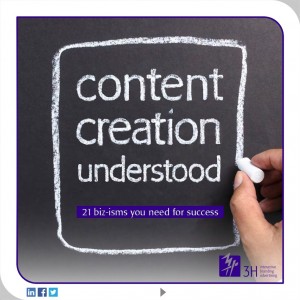
Being in marketing and practicing what we preach (yes we do walk the talk), we’re launching the latest title in our eBook series, Content Creation Understood: 21 biz-isms you need for success. It’s composed of short, snappy insights that will help you wrap your head around creating great content, in less than five minutes!
Coming Up!
Over the next few months, we’re going to follow up the eBook with blogs that expand on some of our biz-isms, so look out for those! Here’s a taste from the 21 ‘biz-isms’ in our eBook: #8 Content is only the first step, #16 Optimize your content.
Content Creation: Are We There Yet?, is a blog we published in May this year. If you think you’re not there yet, it’s the perfect time to download Content Creation Understood. If you think you are there, check it out anyway, there maybe something else you can do to drive your content farther!
Hope you enjoy it! Let us know what you think.
Twitter & Facebook: #ContentCreation #SocialMedia #SharedWisdom
by Miriam Hara | Aug 12, 2015 | Advertising, Agency, Business Success, Communications, Creative, Latest, Management, Marketing
Is the concept of ‘value add’ or ‘value added’ overused? Perhaps it’s more correct to ask, is it misused? Has ‘value added’ become like the tipping issue? Many of us tip automatically, whether it’s deserved or not. Has the term ‘value add’ become interchangeable with just doing a good job, or simply meeting expectations, not exceeding them? What happened to going above and beyond, every time that you can? To me, that’s value added.
The retail landscape is rife with ‘value adds’
The retail landscape is rife with ‘value adds’. Think about extended warranties. You purchase a new refrigerator. You wanted value for your money, so you likely paid for the brand name as well as the fridge’s features and benefits. Brands that have been around for a while, proved their worth, built a following, have intrinsic value. But as you’re buying that brand name fridge, the salesperson encourages you to purchase an extended warranty beyond the standard one-year warranty — a warranty that will protect you — and one you’ll have to pay for. Where’s the value in that?
What is that saying about the product? Shouldn’t you be able to expect that the refrigerator will work for you a heck of a lot longer than one year? And if it’s not going to, then shouldn’t the manufacturer promote an offer to fix anything that does go wrong in the 13th month after you bought it, and fix it for free. That would be a true value added proposition! Same thing goes for a car purchase and the extended warranties that go along with those purchases. Fundamentally, these types of things are not adding real value, they’re just up-selling and increasing the profitability of “you”. I believe I should be able to expect that most high-ticket items that I purchase are going to last a while; that they’re going to meet my expectation of performance, without me having to buy protection in case they don’t.
‘Value added’, from a business owner’s point of view, is having my vendors go beyond… which make them partners… not vendors.
‘Value added’, from my business owner point of view, is having my vendors go beyond. It’s having their service and their staff perform well beyond my expectations, not just meet my expectations. I hired them to meet my expectations. And I’m ecstatic when they exceed them! In other words… you got the business, now keep it by impressing.
In terms of my clients, value added doesn’t mean giving them great creative. They expect great creative. Why else do you go to an advertising agency? It doesn’t mean delivering on time, that’s an expectation from the outset. It doesn’t mean delivering results. That’s expected too.
‘Value added’ happens when we anticipate what the client needs before they need it.
Value added happens when we anticipate what the client needs before they need it. It’s when we nudge them by showing them there’s a better way. It’s by surprising them with things that they didn’t expect; things that help and delight them. Value added is exceeding beyond what our clients expect, and giving them a reason to keep coming back. It’s making them feel good about working with us because not only are we delivering on their expectation, we are adding value to the service and valuing them as clients, by exceeding their pre-conceived expectations. At its core, value added should be about building relationships.
Jump! How High? That’s not value added.
Jump! How high? That’s not value added. Leap as high as I can for my clients before they ask me to jump… now that’s adding value.
What is your idea of ‘value added’ in your ‘world’? I’d be interested to hear!
#ValueAdded #SharedWisdom #ExceedBeyond
by Miriam Hara | Aug 10, 2015 | Administration, Business Success, Communications, Creative, Latest, Management, Problem Solving
I’ve blogged about 7 Things I absolutely Need in a New Creative Hire and my slightly tongue-in-cheek 7 Quirky Questions to Ask a New Creative Hire, but there is another important viewpoint to consider – that of the person you’re hiring. What does the person you’re thinking of hiring absolutely need in order to say ‘yes’ to the hire? Things your new hire absolutely needs from you. ‘Need’ and ‘want’ aren’t the same, remember. In many ways, we all need the same things. What we want varies. We need food, but some of us might want an expensive Vita-Mix to blend, mix, puree or process recipes to make that food. Wants are flexible, needs are not; not if you want a motivated, contributing, satisfied creative employee.
The interesting thing about uncovering what a person needs is that it can help you decide if they are the right person for the job.
The interesting thing about uncovering what a person needs, is that it can help you decide if they are the right person for the job. It lines up with my earlier blog: 7 Things I Absolutely Need in a New Creative Hire. I’ll skip salary talk; that’s related to budgets; yours and theirs, and stick to more universal needs. I’ve been a business owner for many years, so I trust my experience and my instincts when I hire, but I’ll quote the behavioural coaches here. Mostly, my views align. I see all of the following as ‘needs’. No one is ever going to answer in neat little phrases like in the list below, but if you listen carefully, you’ll see what their needs are and which ones are most important. It’s my feeling, that you owe it to your business and to your business’s culture, to see if you can satisfy those needs.
Just because we’re in charge, doesn’t mean we don’t have our own needs and goals.
The list below was put together on LinkedIn by business coach and author, Rick Conlow (I’m summarizing here, the full link to his piece is below) and in my view, warrants repeating and reviewing once in a while, even if we’re not thinking about hiring anyone new. It’s something we all need to check in on. Are the people we’re working with getting their needs met? Are we as business owners and managers getting our own needs met in the jobs we do? Just because we’re in charge of a business or organization, doesn’t mean we don’t have our own needs and goals. Are we getting the same things from our own environment as that new hire is expecting? As I mentioned, I feel Rick’s guidelines are essentially universal and apply to all of us, so don’t think of them as just about the people you’re hiring or have already hired. They apply to all of us. Are we setting or getting:
- Clear expectations and goals.
- Recognition and praise.
- Regular communication with leadership.
- Growth.
- Trust.
- Responsibility.
- Respect.
- Pride in their work.
- Ongoing opportunities to learn.
- Achievement.
I think as Business Owners and Managers, we have a responsibility to remind ourselves, “I know what I need from the people who work for me and how it relates to what the business needs, but what will this new person need?”
Rick’s ‘driving-it-home’ point: “If you want your people to be better, you have to be better as a leader.” I agree. Getting back to that new hire, I think as Business Owners and Managers, we have a responsibility to remind ourselves that “yes, I know what I need from the people who work for me and how it relates to what the business needs, but what will this new person need? Will this job match and meet (at least mostly) their needs?”
Essentially, it’s a symbiotic relationship; if the needs of the person we’re thinking of hiring don’t match fairly closely with what we can deliver and what we believe people really do need, then trouble brews.
LinkedIn. Article by Rick Conlow: The Top 10 Things Employees Want From Their Job.
Additional Reading
Canadian Business. The best cultures, perks and benefits: Canada’s Best Employers 2015: The Top 50
Profitguide.com: The definitive list of organizations that have mastered the art of employee engagement Canada’s Best Small and Medium Employers 2015: The Top 50
Interesting afterthought: This famous study in human behaviour ranks by importance, our hierarchy of needs, in other words, the elements that motivate us: The Theory of Human Motivation by Abraham Maslow Maslow’s Hierarchy of Needs
