by Belinda Lui | Nov 15, 2013 | Latest, Management
Project management is the ability to manage projects, and it is a true artform.
It seems like such an easy task to do, but it isn’t. In today’s fast paced environment, staying on top of the many demands, isn’t as easy at is sounds. True, some industries are more hectic than others, however, all industries have been impacted by the speed of business. We’ve all heard how “Time is Money” – and it doesn’t make it less true just because you’ve heard it a million times.
This is especially true in a billable hours setting when reporting time-spent on work is an integral part of your business. Clients trust that a business will not undercut them and lie about how much time it took to complete a task, but they also expect that the company they hire will manage projects in the most efficient and cost-effective manner.
This is where being organized comes in: you can be smart, fast, sales-focused and all that jazz – but none of it matters if you can’t stay organized. So before getting certified as a PMP, here are some tips on how to be an excellent Project Manager and manage projects effectively, effortlessly:
1. Understand The Project Intimately:
It is crucial to truly understand the task at hand before delivering any promises to your client. There are several elements that come into play when you are organizing a successful project: budget, logistics, time, labour, suppliers, vendors, revisions, etc. Ensure that you have a grasp of what is involved in order to execute a more seamless project.
2. Create A Workback Schedule:
Working backwards seems unnatural – but when you consider the only inflexible element, the deadline of the project, then you’ll understand why everything stems from there. It will also give you a better idea of how much time you actually have for every deliverable that needs to happen before the deadline.
3. Expect The Unexpected:
Murphy’s Law had it right – if something bad can happen, it will. When you are planning a project, expect that there will be several rounds of revisions; a supplier may not deliver on time; the printer will malfunction. My point is: give yourself some wiggle room in case something (and it probably will) bad happens.
Being proactive rather than reactive is a good skill set to have when you need to manage projects. Anticipate that things will go wrong and always stay on top of every task. Project management is an integral part of being successful, regardless of your position or industry. Manage projects or they’ll manage you.
What are some of the effective methods you have used to manage projects successfully?
by Lisa Wedmann | Nov 10, 2013 | Advertising, Latest
 In my opinion cause marketing is the most satisfying type of marketing for any business, large or small. It’s a chance to help their favourite charity and enables businesses, ultimately, to make money.
What is cause marketing? At its simplest form it’s the request for a charity donation at a grocery checkout. You may have participated in a food drive at a local store. This is cause marketing.
When a store links their business to a charity, they raise awareness, involve the community and make money for the cause. The good news is that through their cause marketing support, their company that is associating itself to that cause, aldo benefits in the same ways as the said charity.
Cause Marketing: A win-win
Through cause marketing businesses inadvertently (or not), create awareness towards their brand or business by increasing social engagement all the while MAKE MONEY for the chosen charity. The increased awareness and social engagement bodes well for business and business persona. It shows commitment and develops ties within the community. The bonus: business can help with a cause in which they believe in. Talk about a winning situation.
Some of the largest and most successful companies devote a lot of time and money to supporting and highlighting their cause marketing efforts. TD Canada Trust has their “Friends of the Environment”, Tim Hortons has their “Send a Kid to Camp” and McDonalds has their “Ronald McDonald House”.
Ultimately the cynics out there will look at the obvious… afterall there has to be a financially sound reason for these companies to invest in cause marketing. If these companies didn’t make money, they wouldn’t be able to show this type of support. Well yes in no.
The truth of the matter is that it’s pretty hard to fake cause marketing.
Although some cynics may find it mercenary that companies make money on the coattails of the charities. But on the other hand, it’s pretty hard to fake this type of relationship. Charities believe in what they do. They have a message for the world and they want to get their message out as much as the businesses that support the cause.
When people are giving to charity they are also recognizing your business as trustworthy and committed to the community. As marketer we all know what happens when people recognize and have faith in your business, don’t we?
Cause Marketing is a unique opportunity for businesses to gain awareness and build top of mind recognition with the ultimate goal of promotion sales and hence make money . But those businesses are also good because they do good.
Now that just has to feel good doesn’t it?
by Belinda Lui | Nov 6, 2013 | Communications, Latest
Communication is key.
In all of our relationships, the ability to effectively communicate is crucial to the success of overcoming obstacles. So what do we do when the forms of communication have changed drastically over the past two decades: from conversations over the phone to text messaging; from physical photo albums to sharing images on Instagram; from scrapbooking to repinning on Pinterest; from breaking news at 6pm to getting information at rapid speeds on Twitter.
This shift in communication has changed the way that people communicate but also the way businesses reach their audience.
And in the same way we approach the improvement of our relationships, it is important to outline the key points to effectively communicating to our target audience:
1. Understand your audience:
Never begin a marketing project without first understanding who you’re marketing to. Learn their interests, purchasing behaviour, modes of communication, etc. It is a waste of time to develop any strategy based on assumptions. Knowing your audience gives you the advantage of effectively strategizing the optimal methods in which your audience will be most receptive to. There is never a one-size-fits-all method.
2. Communicate in a way that your audience is comfortable with – not in the way that you are:
There are a lot of companies that prefer the traditional ways of marketing without as much as a hint of interest in learning new methods. The reality is that the world keeps changing around us; and to keep up, we need to change with it. Hashtags, digital media, Smartphone applications – to name a few – are all new additions to the way we market. The Internet has provided businesses with limitless opportunities to reach almost anyone, anywhere, and at anytime. Why wouldn’t you take advantage of this marketing tool?
3. Content, content, content:
In real estate, it’s all about location. In marketing, it’s all about content. How relevant is the material you are using to the consumer in which you are targeting? The Internet serves as an excellent medium to connecting with your audience but with the over-saturation of available information, relevance is also key. The popularity of your posts and the virality of it depend heavily on how relatable they are and the stick factor. Create memorable content – but be sure to integrate relevance into your design.
4. Analysis:
You’ve posted a memorable and relevant message to your Facebook page – now what? It isn’t enough to just post riveting material: we must also gauge the way our audience responds to it. Which types of posts are generating the most buzz? What are the optimal times to post? Are your posts being liked and shared, or is it engaging your followers to comment? Ideally, you will design activations that connect with your audience in all ways (like, share, comment).
5. Follow-up:
Creating posts that allow your followers to create a community amongst themselves is beneficial to your brand – but it is equally important for you to be a part of that community. It is easy for things to slip through the cracks, so it is crucial that you’re paying attention to what your customers are saying (to you and to each other). All comments (good or bad) should be addressed within 24 hours.
In summation, a solid and effective communications strategy can benefit your brand in more ways than you can imagine: keep it simple, open, and relevant. Deliver on your brand promise and in a timely manner. These are just five ways to help improve your communications strategy. In the world of marketing and business development, the options are ever-changing; but the principles remain the same.
Which methods have you found to be effective?
by Miriam Hara | Nov 5, 2013 | Latest, Social Media
There’s much ado about content management these days. In fact, it’s the new buzz word in the social media and marketing landscape. With so many business and brand managers just grappling with the ever-changing dynamics of the worldwide internet and what it means for their business and brand portfolios, content management is yet another aspect of this evolving channel that they need to understand. Content Management is the umbrella of the social media marketing landscape, where content creation strategy plays a significant role under that umbrella.
Like all initiatives in marketing, and more specifically, advertising, achieving critical mass is extremely important in social media. By now, I believe many businesses have come to terms with the fact that social media takes a lot of time and effort. In business terms, that means it’s not free, but nor is it inexpensive. In order for social media initiatives to work, clear goals need to be defined and closely tied into clear and precise strategy. This is what we, at 3H, refer to as Content Creation Strategy. In the social media arena, being without a plan that outlines specific strategy means that businesses are essentially just shooting at random.
Here’s a quick overview of a Content Creation Strategy.
Define your audience: As with marketing, a clear and concise statement of who your target is, is essential. Without it, you are just pushing out content without intent. The beauty of social media is that you can aim… very specifically. Hallelujah! Niche marketing is where it’s at, especially in social media. Why not take advantage of it? Mine the internet and find other like-minded and complementary sites that also speak to your target audience. Define your target: not only by where they go, but by what they do and what they like.
Create a plan: Content creation, like advertising, needs to have a plan. What are the relevant topics for your brand or business? Are there key cycles that you need to build up to and are important? In traditional advertising, if February was Heart Health month, then all the major brands with something to “sell” in heart health would be advertising in February. In the social media environment, there’s no need for that. Slow builds to peak event activity garners greater rewards. At 3H, we establish social media calendars, months in advance. This doesn’t mean that it is set in stone, but the ability to be nimble and flexible on a moment’s notice is key.
Mix it up: Content creation doesn’t only speak to words, blog posts, posts on Facebook, or discussion comments on LinkedIn. Make sure that you blend in a mix of visual(photos) and if possible, video as well. Once you engage in the social media platform, you’ll be surprised how many consumers you have that are your advocates already; sending photos, testimonials and videos and allowing you to share them on your social media properties.
Know where to be: Part of any solid strategy is knowing where to be seen. Assessing the true value of each social media property is essential as well as understanding the must-have versus the nice-to-have. There are so many properties… yet, so little budget. Assess the need to be on every social media property versus the key properties; building towards achieving a broader range and greater reach. That’s what strategy is all about.
If you haven’t established a content creation strategy for your brand or business, then stop what you’re doing… and do it now. Marketing is all about efficiencies, and a content creation strategy plays right into that. Content creation does reap rewards and does provide ROI, but only if, there’s clear objectives and strategy behind the content.
by Lyndsey Loiacono | Nov 4, 2013 | Design, Latest
Designing Restaurants: It’s the outside that counts.
If there is one thing you should know about me, its that I have a huge obsession with food. Cooking, eating, watching food network, I love it all. Growing up in an Italian family and spending hours sitting around a table might have something to do with it. So when thinking of a good topic to share, I thought it would be best to combine my love with food and my love for designing.
I spent 2 of my best years living in Toronto where there are restaurants every where you turn. What makes Toronto a world class city is the diversity in restaurants, but how do they stand out from one another? It seems now more than ever a restaurants brand is as important, if not more important than the food they serve you. It’s your first impression from the outside that brings people inside. Designing a restaurant logo is only one factor in designing a strong and unique restaurant identity.
Here are some great examples of restaurants that got designing appetite appeal right…. from the outside in!
Weslodge, weslodge.com
This new on-the-scene restaurant in the popular king west area, has been branded as a “modern saloon”, with its impossible to miss canary yellow doors jumping right out at you. The interior is dark and feels like you have walked into a twisted pioneer hunting lodge with taxidermy filling the walls. Its logo has a modern back-woods feel to it and that canary yellow is shown very subtlety through menu design. What I love the most about this restaurant is how it celebrates it’s identity by the use of lights on the logo which separates this place from everything else on King west.

Caplansky’s Delicatessen, caplanskys.com
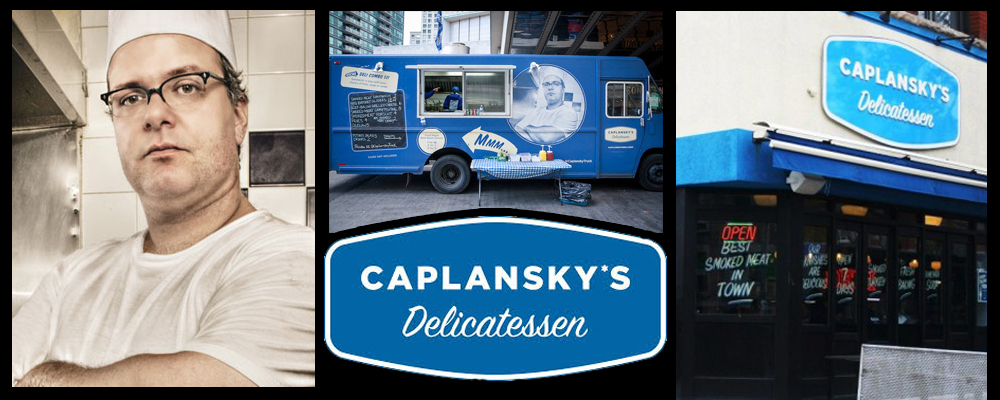
Oh so retro! Zane Caplansky is his brand as seen on the home page of his website dressed as a 60’s breakfast line cook, and good quality kosher food is his game. But before you go inside this eatery, it’s the outside that catches your attention. The retro throw back look is evident in the logo to the paint and design of the actual building. You feel like your looking back in time when your gazing at this place and in many ways you are. It’s simple yet forceful, establishing the Caplansky brand on the the corner of College and Brunswick for the past several years. To top it off, the Caplanksy food truck is a moving brand machine. Going to private events to food truck cook-offs, the proven look of the restaurant is arguably more powerful as a driving diner along the streets of the GTA.
Canteen, oliverbonacini.com
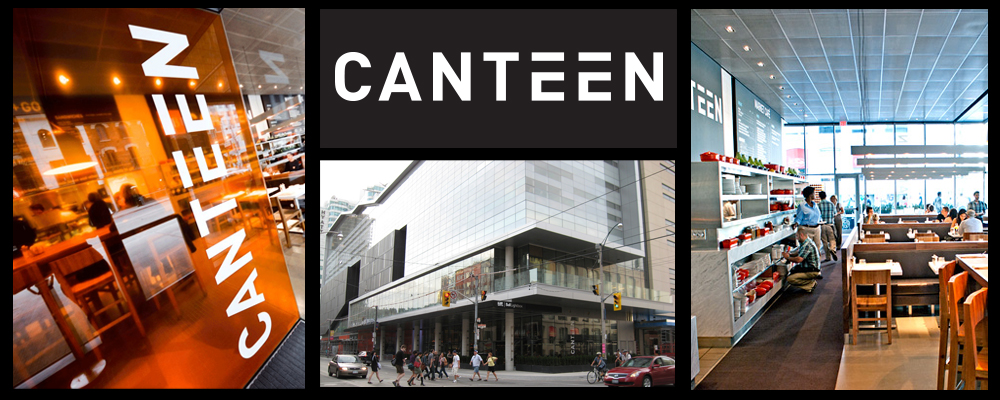
Location, location, location! Ok so were not here to talk about the importance of location, were talking branding. But there is no denying that a superb location is only going to help any company, especially a restaurant, by solidifying it’s brand to the public. Canteen, located in the TIFF building on King street is front and centre in terms of a restaurant establishing it’s identity in the heart of Toronto. The logo itself is what you might call simple. Clean and cut, it makes you think of what a space station eatery might look like but than it’s location in the TIFF building reminds you that this is no ordinary place to eat. The brand is established really by it’s location more than anything. Hollywood meets Toronto for the perfect place to buy an over priced pizza while looking good doing it.