by Lisa Wedmann | Oct 31, 2013 | Advertising, Latest
Advertising frequency is a huge component in the success of any campaign. Think about it: How many times do you need to hear a phone number in order to remember? Don’t answer… it’s a trick question. I have most of my numbers stored in my phone. Not sure about you but I don’t need to repeat phone numbers in order to remember. When I lose my phone or lose my contacts I am in big trouble.
In terms of new advertising and increasing awareness, most people need to repeat or hear an ad or communication three times before it registers. You can test it yourself. Take a name for example. A name that is not a person you know. Like Ryan Clarke. Repeat that name out loud three times. Chances are you will remember…at least in the short term.
Next week rolls around and you might not remember the name. But, if you see Ryan Clarke’s name repeated on Facebook, or an email comes around with this name on it , you might remember the name. Then you might forget … then again you might remember. That’s how building brand awareness works.
Effective Advertising Frequency
In marketing and in advertising, the number of times information is repeated before action is taken is called effective frequency.
There are many theories on what is the proper or correct advertising frequency you should aim for. The number of times you should repeat your information to your target audience is an important factor in the success of any advertising campaign.
There are many marketing theories on how and what strategies should be employed. Get to marketers in a room and each will think that their opinion is the best approach. But where they all agree is that advertising frequency is a must, the information or communications message must be repeated.
It’s not enough to run your ad up the flagpole and assume that your target market will drop everything and salute. Your ad isn’t on a flagpole and really, ads aren’t akin to patriotism. Repeat, repeat, repeat and your message will stick.
The first part of the above statement is obvious. Your message must be heard numerous times before your customer takes action. Marketing of any brand to build awareness must be an ongoing continuous effort in order to be successful.
The second part of the statement is not so obvious, unless you are a seasoned marketing professional. The matter of your messaging sticking is about creative approach, brand persona, media placement and creative strategy.
Approach your customer from different angles. Repeat the same message but repeat it on different channels. Think print, packaging, TV, radio, social media, events, pr and…
I can’t repeat that too many times.
Repeat uniquely, repeat creatively, repeat strategically. Then, your message will stick and your brand awareness rise to the top of the flagpole.
by Lisa Wedmann | Oct 25, 2013 | Advertising, Branding, Business Success, Communications, Latest, Marketing, PR, Social Media
As social media continues to change marketing landscape, one change I have seen is the convergence of marketing with PR. In the past, if you wanted an advertising campaign, you produced commercials, print ads and maybe some billboards.
If you wanted a Public Relations campaign, you used some of the more traditional tactics: a press conference, sent out a press release to media, product placement and TV appearances.
But today, marketing and Public Relations are closer than ever. No more can you launch a great product, with a big ad campaign, and talk TO the consumer.
You have to take it one step beyond that and bring the product to the people, get it in their hands, and talk with them – not AT them.
The overarching goals of Marketing and PR are the same: get people’s attention, get people to connect with, to talk about and, ultimately, buy your product. And finally, perhaps most importantly, it’s about building brand awareness and loyalty.
But that is where the similarity ends. Marketing is about speaking to the consumer. PR today is about speaking with the public and creating a two-way dialogue. With the growth of social media, and the changing landscape of traditional media, power has shifted to the consumer. It’s not enough to speak loudly and blanket the airwaves with ads.
And even if you do blanket the airwaves, finding that target market is increasingly difficult as more and more people are turning out traditional channels, and the media landscaped continues to fracture. In 2012, one in 50 Canadian TV subscribers cancelled cable in 2012, and 130,000 are expected to follow suit by the end of 2013. And Netflix subscriptions are growing, as is the use of PVR – meaning no more commercials!
This is just where PR comes in. A good PR campaign can get the word out to increasingly niche target markets using a mix of tactics: events, blogger campaigns, product placement, media appearances and social media campaigns. Done right, the message will get out to just the right markets and people, creating buzz, awareness, a relationship with the customer, and, ultimately, sales.
There are multiple benefits to a public relations campaign, including:
- Relationships – A blogging campaign will create brand ambassadors, consumers who will talk about your product, and share this with their followers. They will blog, and share about your product, with links back to your website. This also fits in nicely with social media.
- Social Media: Obviously, thanks to the blogger campaign, your followers will grow, and you will connect with new fans and followers. Once bloggers post, and share, their blogs, you can repost on your page, and retweet their tweets. This provides a gateway to new followers, and consumers.
- SEO: Do you produce your website to maximize SEO? A PR campaign will improve your online presence, with links back to the site, which will help the site ranking.
How do you think Public Relations has changed? How does it fit within the marketing mix?
by Miriam Hara | Oct 21, 2013 | Branding, Business Success, Latest
Where is brand awareness today?
Many marketers and business executives don’t value brand awareness as much as they did a decade ago. Some say it’s a thing of the past while others insist that it’s alive and well. For those who are in the former camp, I would urge them to think again. Investors put a lot of stock (excuse the pun!) in brand awareness. In fact, it plays a significant role in determining whether or not they will support a product or company.
Brand awareness is no longer about yelling the loudest and longest. Now it’s really about breaking away from the clutter to make your brand impression count.
Rather than trying to convince non-believers that brand awareness really does increase ROI, the aim of this post is to carve out what the building blocks of brand awareness are in today’s multidimensional market environment.
Be different: In order to develop brand awareness you need to provide your consumer base with something to remember and want to talk about. Your brand needs be solid and stand out through its brand persona, premise and brand positioning. It’s not enough to just talk at people anymore, brands must engage and interact with their audience. This is becoming increasingly important for building solid brand awareness. In order to do that, your brand needs to establish a voice and tone.
Get found: It’s important that your marketing strategy includes a strong SEO component. This should include a comprehensive online advertising campaign or a google keyword campaign.
Be engaged: One of the marketing channels available to us now is social media. How effectively you use this channel can mean the difference between success and failure. So it’s important that your marketing plan include a social media strategy in order to increase engagement and build upon your other SEO initiatives.
Be holistic: Don’t just rely on new media, make sure you have a good dose of traditional media too. I often laugh when people say, “Traditional media is no longer effective”, especially when I come across 30 second TV or radio ads urging me to go to Facebook and “Like” them! And yes, you’ll also find the same message in print media. But regardless of what channel you choose to communicate in, make sure that all your communications tactics drive your point of contact to the same place.
Be consistent: Don’t rely on a one hit wonder, especially with branding! It takes a solid, consistent commitment to build brand awareness. The good news is that with social media, relative to traditional media, being “out there” doesn’t necessarily take a lot of money – but it does take a lot of time and planning.
Be website ready: There’s nothing worse than having your audience listen and engage with your brand only to direct them to a website that isn’t primed to take advantage of that opportunity! First impressions count. And in today’s environment, that means your website has to perform well by creating a positive experience to potential consumers and customers.
How do you feel about building brand awareness in the current market conditions? And what have you done to outperform your competitors?
Please share your thoughts here…
by Lindsay Sleightholm | Oct 16, 2013 | Branding, Design, Latest, Marketing
Though I’m a big music fan, I’m not going to pretend I know much about the actual music industry. But I do know a lot about graphic design and have my share of marketing know-how. And I recognize that there’s a lot more to creating an iconic band than great guitar riffs and a good-looking lead singer.
Is a band a brand?
Some bands are just bands. They’re not interested in creating an identity for themselves beyond what their music conveys. Although bands who want to get to the next level know that the business of music is not unlike any other business – it requires the use of marketing, advertising and design. Like anything else, good branding can help distinguish them among the competition. Bands have their own identities. Yet as musicians they’re not just creating music, they’re also shaping a brand persona – whether this was their intention or not.
Does a band need marketing and design?
Just like any other brand, a band needs to find its audience and connect with them. This happens of course through their music. However it is also created by the interactions they have with their audience, their public performances and appearances, their official and unofficial videos on YouTube, their presence on social media and their visual identities.
This is where the marketing and design comes in. Visual identities are created in order to market the music. These identities can end up on every facet of their visual branding – from T-shirts to websites. Some of the most successful bands of all time have made great use of this visual medium.
Band brands
So putting my music tastes aside, I’ll throw on my designer hat for my picks of some of the best in band branding.

Kiss
If you google “kiss”, you’ll actually get the band Kiss – which in itself is pretty impressive. Originally known as Wicked Lester, headed by Gene Simmons and Paul Stanley in 1971. But it wasn’t until 1973 that the name change to Kiss came about and a new image was born. The Kiss logo was first developed by their original lead guitarist Ace Frehley, later to be polished by designer and illustrator Michael Doret.
Since then, they haven’t just put it on a few posters and T-shirts – they ran with it. Combined with their trademark make-up and costumes, the entire Kiss brand has been built into a music empire spanning over four decades.
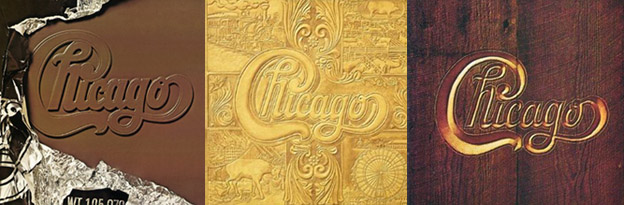
Chicago
Starting out as cover band The Big Thing in 1967, a name change to The Chicago Transit Authority in 1968 was short-lived due to the threat of legal action from the actual Chicago Transit Authority. By the 1970’s the band became simply Chicago. Their final name logotype was designed by art director John Berg.
That logo has since fronted nearly all of the band’s album covers – taking on a different illustrative style each time – yet remaining true to its original design. It has also earned its place in design history, with a nod from designer and author Philip B. Meggs, in Type and Image: The Language of Graphic Design.

Daft Punk
The French duo that in 1992 was originally called Darlin’, after the Beach Boys song, quickly re-branded themselves as Daft Punk after receiving a negative review describing their music as “a daft punky thrash”.
By the latter half of the 90’s Daft Punk were beginning to not only carve out a place for their unique sound but their solid, albeit unconventional, visual brand. Known now for their look as much their music, the two robot-human hybrids have created an image for themselves without ever showing their faces.
These bands, although completely different in musical genre, have at least one thing in common, they have really taken advantage of branding to boost their identities – as have hundreds of other music greats. The music is their product, but they’ve also crafted a marketable image. And each is an example of how consistent branding can help propel any brand, or band, to the next level.
As most know, a good one-off will only give you your 15 minutes. But great branding, effective marketing and strong design can take what is already unique and give it the stage to really stand apart.
by Miriam Hara | Oct 15, 2013 | Branding, Business Success, Latest
A recently shared post written by a colleague about branding promise hit a nerve among marketing professionals. Brand identity value has been a growing cause of concern and debate among those who are in charge of managing and growing brands. Let me say this:
Branding is not dead. And brand identity value is very much alive and changing.
What is required for developing and building a brand identity has evolved. This should not come as a surprise… the market landscape that brands have to communicate effectively in has changed. In the post outlining the importance of brand promise cited above, some felt that the evolving customer journey had left brand, brand identity value and brand premise in the dust. But how accurate is that?
The popularity of social media combined with brand advocates are at the crux of the changing market environment. The customer journey has become a key factor in the implementation of any successful strategies involving brand development and increasing brand identity value. Suffice to say that the social media channel has allowed for the rise of so many niche communities within the social media arena enabling relevant brand advocates. In order to resonate with the evolving and very “vocal” consumer, brand makers and the art of branding itself have been forced to forge new ground.
The fact that consumers now have a voice and can easily “hurt” a brand is true. But the flip side to that argument is that consumers can also use their voice to propel a brand forward. Marketers and the brands who embrace that knowledge while treading cautiously within this channel can reap substantial brand identity wins.
The premise of brand identity value has become increasingly dimensional as it now encompasses brand voice and brand tone to round out its brand persona. No longer are those characteristics reserved to a few brands with hefty budgets. Today any brand, big or small, can dive in and become a dimensional brand. That doesn’t mean that adherence to the basics of building a brand and its identity should go by the wayside – quite the opposite. Due to the immediacy of social media and the often reactionary, volatile nature of the channel, the establishment of brand identity, its guidelines and adherence to character and tone play a significant role in achieving and building a relevant brand identity.
So what do you feel is necessary for a brand to do to keep up its value and relevancy in this market environment?
