by Belinda Lui | Nov 25, 2013 | Advertising, Latest
Soon after Halloween passes (literally, November 1), the Christmas paraphernalia goes up. I used to be nauseated by how money-driven retailers must be to shove money-spending down our throats. Then, I remember that the Christmas music also starts soon after on the radio, and most importantly, the Christmas-themed commercials.
Seasonal advertising is probably one of my favourite type of advertising – it gives copywriters and art directors an opportunity to encapsulate the emotions felt during every holiday and prompt some sort of response from its viewers/listeners.
Here are a few of my most anticipated Christmas advertising:
1. Coca-Cola
From their seasonal packaging to their feel-good advertisement spots, Coca-Cola is definitely number one on my list of favourite Seasonal Advertising Campaigns.
2. M&Ms
Who wouldn’t love the two M&M characters? Seeing these animated chocolates, with whom a lot of us have grown a kinship with over the years, live out the innocence of preparing for Santa Clause’s arrival – brings back the memories in 30 seconds (or less).
3. Tim Hortons
Tim Hortons definitely gets the “feel-good”, “patriotism”, and “family” notions spot-on. Who doesn’t like a bit of those things during the holidays?
4. Old Navy
If you’re the type of person (and who isn’t?) that appreciates an upbeat, jolly, dance number – then you would look forward to these commercials too.
5. Target
Still considered to be fairly new to the Canadian market, Target has the ability to capture feel-good and “hip and trendy” in the same ad spot.
While the underlying goal in every advertisement is to push sales, it is no wonder why marketers spend most of their ad money in the fourth quarter: people are more willing to spend during the holiday season and are vulnerable to the emotions that come along with Christmas. Still, if only for the appreciation of great creative work: I thoroughly look forward to Seasonal Advertising Campaigns.
What are some of your favourite Seasonal Advertising Campaigns?
by Lisa Wedmann | Oct 31, 2013 | Advertising, Latest
Advertising frequency is a huge component in the success of any campaign. Think about it: How many times do you need to hear a phone number in order to remember? Don’t answer… it’s a trick question. I have most of my numbers stored in my phone. Not sure about you but I don’t need to repeat phone numbers in order to remember. When I lose my phone or lose my contacts I am in big trouble.
In terms of new advertising and increasing awareness, most people need to repeat or hear an ad or communication three times before it registers. You can test it yourself. Take a name for example. A name that is not a person you know. Like Ryan Clarke. Repeat that name out loud three times. Chances are you will remember…at least in the short term.
Next week rolls around and you might not remember the name. But, if you see Ryan Clarke’s name repeated on Facebook, or an email comes around with this name on it , you might remember the name. Then you might forget … then again you might remember. That’s how building brand awareness works.
Effective Advertising Frequency
In marketing and in advertising, the number of times information is repeated before action is taken is called effective frequency.
There are many theories on what is the proper or correct advertising frequency you should aim for. The number of times you should repeat your information to your target audience is an important factor in the success of any advertising campaign.
There are many marketing theories on how and what strategies should be employed. Get to marketers in a room and each will think that their opinion is the best approach. But where they all agree is that advertising frequency is a must, the information or communications message must be repeated.
It’s not enough to run your ad up the flagpole and assume that your target market will drop everything and salute. Your ad isn’t on a flagpole and really, ads aren’t akin to patriotism. Repeat, repeat, repeat and your message will stick.
The first part of the above statement is obvious. Your message must be heard numerous times before your customer takes action. Marketing of any brand to build awareness must be an ongoing continuous effort in order to be successful.
The second part of the statement is not so obvious, unless you are a seasoned marketing professional. The matter of your messaging sticking is about creative approach, brand persona, media placement and creative strategy.
Approach your customer from different angles. Repeat the same message but repeat it on different channels. Think print, packaging, TV, radio, social media, events, pr and…
I can’t repeat that too many times.
Repeat uniquely, repeat creatively, repeat strategically. Then, your message will stick and your brand awareness rise to the top of the flagpole.
by Lisa Wedmann | Oct 25, 2013 | Advertising, Branding, Business Success, Communications, Latest, Marketing, PR, Social Media
As social media continues to change marketing landscape, one change I have seen is the convergence of marketing with PR. In the past, if you wanted an advertising campaign, you produced commercials, print ads and maybe some billboards.
If you wanted a Public Relations campaign, you used some of the more traditional tactics: a press conference, sent out a press release to media, product placement and TV appearances.
But today, marketing and Public Relations are closer than ever. No more can you launch a great product, with a big ad campaign, and talk TO the consumer.
You have to take it one step beyond that and bring the product to the people, get it in their hands, and talk with them – not AT them.
The overarching goals of Marketing and PR are the same: get people’s attention, get people to connect with, to talk about and, ultimately, buy your product. And finally, perhaps most importantly, it’s about building brand awareness and loyalty.
But that is where the similarity ends. Marketing is about speaking to the consumer. PR today is about speaking with the public and creating a two-way dialogue. With the growth of social media, and the changing landscape of traditional media, power has shifted to the consumer. It’s not enough to speak loudly and blanket the airwaves with ads.
And even if you do blanket the airwaves, finding that target market is increasingly difficult as more and more people are turning out traditional channels, and the media landscaped continues to fracture. In 2012, one in 50 Canadian TV subscribers cancelled cable in 2012, and 130,000 are expected to follow suit by the end of 2013. And Netflix subscriptions are growing, as is the use of PVR – meaning no more commercials!
This is just where PR comes in. A good PR campaign can get the word out to increasingly niche target markets using a mix of tactics: events, blogger campaigns, product placement, media appearances and social media campaigns. Done right, the message will get out to just the right markets and people, creating buzz, awareness, a relationship with the customer, and, ultimately, sales.
There are multiple benefits to a public relations campaign, including:
- Relationships – A blogging campaign will create brand ambassadors, consumers who will talk about your product, and share this with their followers. They will blog, and share about your product, with links back to your website. This also fits in nicely with social media.
- Social Media: Obviously, thanks to the blogger campaign, your followers will grow, and you will connect with new fans and followers. Once bloggers post, and share, their blogs, you can repost on your page, and retweet their tweets. This provides a gateway to new followers, and consumers.
- SEO: Do you produce your website to maximize SEO? A PR campaign will improve your online presence, with links back to the site, which will help the site ranking.
How do you think Public Relations has changed? How does it fit within the marketing mix?
by Lindsay Sleightholm | Oct 16, 2013 | Branding, Design, Latest, Marketing
Though I’m a big music fan, I’m not going to pretend I know much about the actual music industry. But I do know a lot about graphic design and have my share of marketing know-how. And I recognize that there’s a lot more to creating an iconic band than great guitar riffs and a good-looking lead singer.
Is a band a brand?
Some bands are just bands. They’re not interested in creating an identity for themselves beyond what their music conveys. Although bands who want to get to the next level know that the business of music is not unlike any other business – it requires the use of marketing, advertising and design. Like anything else, good branding can help distinguish them among the competition. Bands have their own identities. Yet as musicians they’re not just creating music, they’re also shaping a brand persona – whether this was their intention or not.
Does a band need marketing and design?
Just like any other brand, a band needs to find its audience and connect with them. This happens of course through their music. However it is also created by the interactions they have with their audience, their public performances and appearances, their official and unofficial videos on YouTube, their presence on social media and their visual identities.
This is where the marketing and design comes in. Visual identities are created in order to market the music. These identities can end up on every facet of their visual branding – from T-shirts to websites. Some of the most successful bands of all time have made great use of this visual medium.
Band brands
So putting my music tastes aside, I’ll throw on my designer hat for my picks of some of the best in band branding.

Kiss
If you google “kiss”, you’ll actually get the band Kiss – which in itself is pretty impressive. Originally known as Wicked Lester, headed by Gene Simmons and Paul Stanley in 1971. But it wasn’t until 1973 that the name change to Kiss came about and a new image was born. The Kiss logo was first developed by their original lead guitarist Ace Frehley, later to be polished by designer and illustrator Michael Doret.
Since then, they haven’t just put it on a few posters and T-shirts – they ran with it. Combined with their trademark make-up and costumes, the entire Kiss brand has been built into a music empire spanning over four decades.
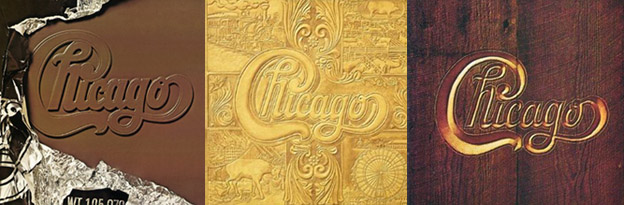
Chicago
Starting out as cover band The Big Thing in 1967, a name change to The Chicago Transit Authority in 1968 was short-lived due to the threat of legal action from the actual Chicago Transit Authority. By the 1970’s the band became simply Chicago. Their final name logotype was designed by art director John Berg.
That logo has since fronted nearly all of the band’s album covers – taking on a different illustrative style each time – yet remaining true to its original design. It has also earned its place in design history, with a nod from designer and author Philip B. Meggs, in Type and Image: The Language of Graphic Design.

Daft Punk
The French duo that in 1992 was originally called Darlin’, after the Beach Boys song, quickly re-branded themselves as Daft Punk after receiving a negative review describing their music as “a daft punky thrash”.
By the latter half of the 90’s Daft Punk were beginning to not only carve out a place for their unique sound but their solid, albeit unconventional, visual brand. Known now for their look as much their music, the two robot-human hybrids have created an image for themselves without ever showing their faces.
These bands, although completely different in musical genre, have at least one thing in common, they have really taken advantage of branding to boost their identities – as have hundreds of other music greats. The music is their product, but they’ve also crafted a marketable image. And each is an example of how consistent branding can help propel any brand, or band, to the next level.
As most know, a good one-off will only give you your 15 minutes. But great branding, effective marketing and strong design can take what is already unique and give it the stage to really stand apart.
by Miriam Hara | Aug 29, 2013 | Advertising, Communications, Creative, Latest, Marketing
It’s difficult to stay on trend today. Within minutes of an event it’s viral. Next week it’s old news. And it’s not hard to predict. I can safely predict today that by the time you read this blog Miley Cyrus and Robin Thicke will be replaced by another event that’s just as newsworthy.
And there’s no greater sure death for any marketing or advertising campaign than being out of date. Like I said it’s not easy to stay on trend. It’s not all bad. We do have some advantage in that we can easily and quickly update our sites and tweet the latest.
But, not every project or campaign can enjoy the velocity of the web. Design takes time. Printing takes time. Radio takes time. Photography takes time. So many aspects of marketing and advertising take time to produce no matter how fast we work.
But there are a few simple strategies that can help you keep on top and stay on trend.
Stay on trend with the classics
There’s a reason something is classic. A classic has stood the test of time and still comes up winning. It’s not simply because it’s a favourite. A classic implies continuance and consistency while at the same time adapting to our conventional point of view.
You can’t get older than ancient Greece. Well yes you can, but you have to agree ancient is pretty old. And you wouldn’t really think that staying on trend would mean stealing from the Greeks. Or would you?
Who could be more on trend than Nike? Yet, Nike chose its name from Greek mythology. Nike is the goddess of victory. A “classic” example where a brand has reached into the past and adapted it to fit the modern market.
We all know Amazon.com and Mars candy bars. The Apollo Theatre is a famous music theatre in New York. And I’m not going to even talk about Trojan.
Stay on trend with old ideas
There are times where an idea didn’t work. It wasn’t a bad idea but it didn’t work during that particular moment. Hang onto these ideas. Next time when you want to jump on trend, resurrect those ideas. You are already ahead of the game. You can capitalize on the time you saved and jump that much faster on trend.
Stay on trend by pulling from the past
Radio and TV and other media outlets create material ahead of time on news that hasn’t happened yet. This allows them to stay on trend and be current. They pull information from the past and use it to provide content to complement upcoming news. For example, there was lots of background material that made it easy to prepare fill in for William and Kate before the birth of Prince George.
And when you take it one step farther, it was easy to prepare two versions of the event. Boy or girl? People want to know what happens to lineage based on the sex of the baby. Easy to prepare ahead of time. As soon as the birth is announced up pops material that was already prepared.
Stay on trend with Mark Twain
There’s no argument that staying on trend means understanding your target market. That’s where your professional ability comes into play. But when staying on trend is getting your frazzled, there is some pleasure in Mark Twain thoughts on the subject.
“There is no such thing as a new idea. It is impossible. We simply take a lot of old ideas and put them into a sort of mental kaleidoscope. We give them a turn and they make new and curious combinations. We keep on turning and making new combinations indefinitely; but they are the same old pieces of colored glass that have been in use through all the ages.”
Perfectly said!
