by Felicitas Ritter | Feb 10, 2014 | Creative, Latest
Whether you are tasked to come up with ideas for a corporate creative campaign using a team of people, or you are just trying to generate ideas for yourself, the process of “brainstorming” is virtually the same. It doesn’t have to be an intimidating process and hopefully the idea of facilitating a session doesn’t strike in you with the same kind of blinding fear it did in me the first time I had to lead one – which happened when I was barely an account executive, with half the agency present, including the Big Boss, and The Client! But not only did I survive, I gained tremendous confidence through the challenge and (I think) managed to impress a few people.
1. Preparation: When it comes to involving other people in a brainstorming session, how well you prepare everyone for it BEFORE they get there is important. Provide a one or two page outline including background on the situation, the issues, and the competition, as well as some direction as to the kinds of ideas you are looking for. Send this out a few days in advance of your session to give people time to ruminate about it. I find that when I’m coming up with ideas it sometimes takes a few hours of just sitting with the concept in my mind before ideas really start to flow. Suggest that your participants take note of any thoughts and bring those with them into the session to share – this will also help to get things started.
2. Relaxed atmosphere: Where you get creative is equally important. A room that is comfortable, quiet, and without distraction will help people focus on what you are trying to accomplish. Also, keeping the atmosphere friendly and inviting so people will feel free to contribute is key. No stuffed shirts allowed. Otherwise, you’ll just get the same old boring ideas, from the same old people and that may result in a less effective campaign. In fact, working with a more diverse group should be your objective.
We all come from different places and you want to take advantage of unique perspectives.
3. Scheduling: According to Mind Power News http://www.mindpowernews.com/BestTimeOfDay.htm the most productive time of the day to generate ideas is between 9am and 11am. This is when your brain has activated enough of the stress hormone, cortisol, to allow your mind to focus and be creative. Having light snacks, such as fruit and nuts, and keeping everyone hydrated is also a good idea.
4. No negativity: It’s all good… or not. But don’t start judging anything until the session is done. Certainly not all ideas are going to be stellar, but that luke-warm, never-gonna-fly, embarrassed-you-said-it idea could lead to the next latest and greatest one. You owe it to the team (or yourself) to just put it out there – plant the seed and see what develops, for you or someone else in the group. That crazy idea could lead to something truly original and creative.
5. Post it: Write all the ideas on a board (or several boards) around the room so everyone can see them. Having all your ideas front and center will help maintain focus and flow.
6. Visual Aids: Using images can also be helpful to stimulate creative thinking. Ask people to bring tear-sheets from magazines, or print-outs from inspiring web content. Put those up on the wall too. There also some amazing online programs and apps available to help you organize your ideas: Pinterest, Wordstorm, Springpad, and Popplet are just a few.
7. Organize & Evaluate: As you are writing down ideas, try to keep them in some kind of cohesive order. When you have what you consider to be enough to work with, filter through them all categorically and see if you can expand on anything that you particularly like. Once everything has been explored to the fullest, you should be ready to put together a strong and comprehensive creative campaign strategy.
by Belinda Lui | Jan 31, 2014 | Latest, Social Media
It isn’t news that the festivities and anticipation surrounding the upcoming Super Bowl XLVIII is followed none other by the advertising creative that will be airing during the Super Bowl! What follows closely behind these 2 most in virality, however, is the social media activity that is expected to blow up during this annual sporting event. Among these and those who were surveyed, 61% declared that they would share the ads on social media. 41.2% said that they would be active on social media before, during, and after the game. 55.8% of these users planned to share content primarily on Facebook. This event is anticipated to be the most sociable Super Bowl of all time!
What other facts contribute to making this the most sociable Super Bowl of all time?
- 93% of viewers will discuss ads with their peers
- 61% of viewers will share ads on social media
- 1 in 4 viewers will likely post about Super Bowl ads on social media before the game
- 37.6% of viewers will look up Super Bowl ads before the game
- 67.4% of viewers will likely post about Super Bowl ads on social media during the game
- 65.3% of viewers will likely post about Super Bowl ads on social media after the game
- 62.2% of viewers will re-watch ads after the Super Bowl
When CrowdTap asked “After the Super Bowl, which are you more likely to like or follow on Facebook or Twitter?”
The results were: 73% brands, 27% teams.
So, as you can see – the emerging trends in marketing and advertising during the Super Bowl has taken a major turn towards a more sociable strategy. It isn’t enough that people can watch an ad in between watching the game; they will want to watch them before, during, and after the game as well. Given that these brands are successful in getting a message across, they might even gain some new followers on social networks.
Have you ever shared ads in social media before? Come back after the game and let us know which Super Bowl ads were your favourites?
by Lindsay Sleightholm | Dec 18, 2013 | Advertising, Latest
As we all know, any retail brand that doesn’t get on board with holiday advertising is missing out. A lagging year of sales can be more than made up for within the last couple of months with a successful holiday campaign.
Since the 1920s, The Coca-Cola Company has been doing just that – and for good reason. The initial strategy was to position Coca-Cola as a year-round refreshment in North America, despite the fact that the drink, best served cold, isn’t what most would reach for during the holidays. The benefit of their strategy is twofold: Get people drinking a cold beverage during the winter, while reaping the rewards of holiday spending.
Today, The Coca-Cola Company is one of the best at emotive advertising during this festive time of year.
But how do they do it so well? Maybe it’s because of the product’s red and white branding that is synonymous with Christmas – the holiday that Coca-Cola primarily focuses their seasonal advertising efforts around. Or maybe it’s because the brand image they’ve built up over the years really focuses on relationships, sharing and happiness – all of the warm and fuzzy feelings that consumers crave this time of year. Or maybe it’s just because they’ve been doing it a little bit longer than most.
Rather than guessing, let’s take a look at some of the holiday advertising efforts from a brand that really knows how to capture our emotions and make the most of this retail season.
Santa Claus
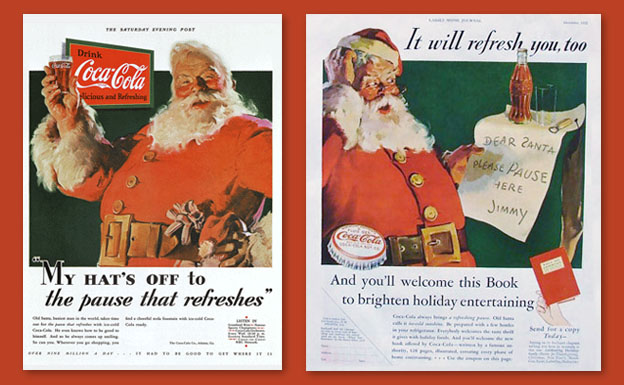
1931 marked the start of the Coca-Cola Christmas advertising campaign that would end up greatly influencing the image of the modern day Santa Claus. It was the interpretation of artist Haddon Sundblom, who was inspired by Clement Clarke Moore’s 1822 poem “‘Twas the Night Before Christmas”, that gave life to the Company’s jolly old Saint Nick. The Coca-Cola Santa could often be seen taking a break from his hectic Christmas schedule to enjoy a bottle of Coke.
 The Polar Bears
The polar bear image arrived within Coca-Cola advertising in the early part of the 20th century, appearing in print as early as 1922. Although, it wouldn’t be until 1993 that the cuddly white creatures really came to life, during the company’s “Aways Coca-Cola” TV campaign. With help from the vision of creative Ken Stewart, Coca-Cola was able to go one step further with the bears. Thanks to sophisticated computer animation, they were able to portray human-like personalities, while enjoying all the festivities of the Christmas season in the great white north – complete with Coke. “That’s really what we were trying to do – create a character that’s innocent, fun and reflects the best attributes we like to call ‘human,’” said Stewart.
 Holiday Caravan
In 1995, Coca-Cola took their holiday advertising to a truly on-the-ground level when they started rolling out a fleet of extra special delivery trucks, each decked out in Coca-Cola Christmas branding, lit up with hundreds of holiday lights and emblazoned with the phrase, “Holidays are Coming!” What started as a TV campaign now includes a rigorous agenda of actual trucks making stops at hundreds of towns around the world, with the aim of delivering some of the celebration of the season right to the consumer. For many, the trucks have now come to symbolize the official start of the Christmas season.
 After almost a century of making Christmas a top priority in their sales year, Coca-Cola has all-but cornered the market on holiday advertising. But it really doesn’t matter what you’re selling at this time of year. What matters is how you’re able to tap into the emotions of your market during the holidays. Whether you’re toting Christmas, Hanukkah, Kwanzaa or something much more holiday-neutral, what’s important is your approach to the message. If we’ve learned anything from Coca-Cola’s success, it’s that your message needs to be emotive, genuine, empathic, and it needs to appeal to everyone – from the uber-holiday enthusiast to the biggest cynic.
If you can tackle all that, your consumers will pay attention and your bottom line will reap the rewards.
by Belinda Lui | Dec 11, 2013 | Business Success, Latest
As Heraclitus so succinctly put it, “The only constant in life is change”. As people, some of us struggle daily in order to adapt to the changes that life thrusts upon us. As professionals, the same theory applies. The workplace, the marketplace, even the avenues in which we conduct our business are changing at rapid speeds – so how do we stay on top of it all? How do we ensure that we are doing what it takes to be ahead of the game?
There are probably plenty of ways, but I’ve compiled a list that has helped me stay relatively successful with change, in work and in life:
1. Know your strengths and weaknesses
With a Type-A personality, I like to believe that I can do anything and everything; under budget, on-time, and better than anyone else can. It’s humbling to discover, however, that failures are blessings in disguise. They teach you how to be better. If you learn from your mishaps, you will sooner recognize where you sink and where you swim.
2. Persistence
Failing at things is a good thing. Success doesn’t look like smooth-sailing; it looks a whole lot like multiple do-overs, learning from your mistakes each time. The discovery step on the road to success and embracing change, is probably my favourite. Keep failing until it works. To quote the late Nelson Mandela, “Do not judge me by my successes, judge me by how many times I fell down and got back up again”.
3. Motivation
Realizing that nothing stays the same for very long, it isn’t ideal to remain idle in anything that you do. Even when you’ve mastered a skillset, you must remain motivated to stay current with emerging trends. What motivates you? For me, it’s working in a position that continually challenges me to be better at what I do, no matter what that may entail. Figure out what motivates you and keep reminding yourself of this when things seem unbearable.
4. Work/Life Balance
What’s that? With the uprising of Social Media and Technologies, you’re almost always connected to your workplace. It’s important to keep your work life and your personal life separated, however, even if that means putting your SmartPhone somewhere where you won’t be tempted to respond immediately. You can set aside dedicated time slots throughout the night to check work e-mails but it is easy to get carried away when these boundaries are not clearly defined.
Change is inevitable, but hopefully this list gives you some insight on how to more readily embrace it.
What are some of the ways that you deal with change?
by Lisa Wedmann | Dec 2, 2013 | Latest, Marketing
As 2013 is ending, budgeting for 2014 is well under way. In fact, for many companies budgets and the business plans for 2014 are already in place. But the piece that is often missing is the marketing plan.
The marketing plan will include a list of actionable items to be implemented throughout the year. This plan will be the “bible” for the year. It should clearly identify:
- Define goals and targets, monthly, quarter and yearly, and how you will measure success;
- Define strategic activities you will undertake that will help to reach goals and targets;
- Define audience for each activity;
- Define who is involved and responsible for each activity
This plan needs to be based on defined objectives and the strategies that will, in effect, achieve the objectives. Without a sound strategic base, the marketing plan will be of little use. So how do you go about creating this?
The best place to start is looking back at the previous year, and also carefully analyzing the company’s strengths and weaknesses, and the competitive landscape. How do you do this?
A solid and must have start is to do a S.W.O.T. analysis. What is a S.W.O.T? It is an examination of the Strengths, Weaknesses, Opportunities and Threats facing your business. This analysis will help you to identify key insights on where your brand or business is within the market landscape, competitive arena and also assist in establishing brand tone, persona and voice. It will assist in developing strategic plans to move forward. You will be able to pinpoint what makes you different from your competitors (USP), what the strengths and weaknesses are, and where opportunities lie moving forward.
Next, take a look at what we call, “Lessons Learned”. Review the year, and every program, from beginning to end. This goes beyond just looking at the end results. Yes, meeting goals and targets is important, but there are other key learnings to be taken from the program: 1) were all departments on board? 2) Was there an internal communication breakdown? 3)Was the timing off, to name only a few. Write it all down. Out of this review will come 4 lists:
- What worked – and why!
- What didn’t work – and why!
- Lessons Learned – what did I learn about this?
- Recommendation on moving forward.
Just starting with these 4 lists, S.W.O.T and “Lessons Learned”, you will have a good place to start as you lay out your plans for 2014. These three analyses will help you clearly define a direction, target audience, competitive landscape and media channels that will help you to build a successful and memorable 2014!
Do you have a marketing plan for 2014? How do you begin your plan?
