by Joyce Turner-Gionet | Aug 19, 2015 | Advertising, Business Success, Communications, Latest, Marketing
Most of us want more: more time, more fun, maybe more money, more apps and upgrades to help us do what we do faster and more efficiently, more stuff to help us minimize chores we hate doing. I believe in ‘more,’ I do. (I want to take more trips!) If something can help me do more in less time, measurably less time, and the time saved allows me to do other things, then it’s all good. If ‘more’ can help me deliver more value to my clients, then obviously, that’s good too. If ‘more’ is going to make me happier, for more than the time it takes for the novelty to wear off, then I’m more-ish! What got me thinking about the value of ‘more’ was a comment this week from my cell phone provider.
Do I need MORE?
“You’re eligible for an iPhone upgrade.” Granted, the upgrade isn’t free. No, I won’t get the latest model, unless I want to pay a LOT more; but I’d get a model that gives me more than the 2013 model I have now. I got excited. I’m an Apple fan from way way back. It was tempting. I’d get a bigger screen with greater pixel density, a more powerful processor, a battery that will last twice as long, a better camera — all good things, all stuff I’d like to have; but that’s not my point. Do I need more? Right now, my phone does what I want it to do, but …
MORE is so tempting…
My MacBook Pro’s getting old. I could do with a lighter, faster, more powerful model; okay, a sweeter one than the one I’ve got.
Apple’s advertising — as always — is smooth, intelligently simple and exciting. For the latest MacBook Pro, it’s particularly appealing: Hey, Joyce, with the new Force Touch trackpad “you don’t just see your content, you feel it.” Hey, Apple! I’m all for “feeling” my content, I’m a writer. The subhead reads: “Press a little deeper, do a lot more.” I’d be able to look up a word in the dictionary by simply pressing a little harder on the trackpad; it can distinguish between a hard touch and a softer one. Haptic feedback, aka kinesthetic communication, is a marvellous thing. (Haptic is from the Greek, relating to our sense of touch.) The new model would scan my retina, bypassing the need to enter my user name and password. Maybe that would prevent my daughter from ‘borrowing’ my 15˝ laptop to watch Netflix on a larger screen (hers is 13˝ and just not big enough for enjoying her shows, it seems). But since I’m not storing secrets that could rock the world on my laptop, do I need retinal security?
But will they allow me to do MORE?
“A groundbreaking retina display. A new force-sensing trackpad. All-flash architecture. Powerful dual-core and quad-core Intel processors. Together, these features take the notebook to a new level of performance. And they will do the same for you in everything you create,” says Apple.
Wow! All of that makes my laptop seem about as current as the era in which we hominids split with our ancestors, the chimps, to walk upright. I could have all of this really cool stuff and I’d love it. But will those features, as Apple’s copy suggests, take everything I create to a new level? Will they allow me to do ‘more’? Maybe!
How much MORE do we need? How much is MORE really going to give us?
I’ve had conversations with my geek pal about ‘more’; he gets excited about the near future and the far future and how much more we’ll be able to do. It’s an exciting world and yes, we need to anticipate, stay current, stay relevant and lean on technology to help us work smarter. Use it and yes, upgrade it, to enrich our lives and make things better in all of the ways that it can. But every once in a while (even if it’s just delaying the inevitability of those unrecyclable parts from my iPhone ending up as e-Waste) shouldn’t we question the value of more? How much more do we need? How much is ‘more’ really going to give us?
The job of advertising is to persuade
The smarter the advertising, the more persuasive. Apple can be very persuasive; but at the end of the day, it still falls to me to be persuaded.
In the near future, NO new phone; but I do see a laptop – if only to get me to the dictionary faster and put that retina scan to work cramping my daughter’s laptop-borrowing style! And it would be really nice to schlep around a lighter laptop. For this week, though, I’ll forego the enticing bells and whistles, stick with my old laptop and continue doing more, with less. I’m not quite ready to be persuaded.
For a futuristic perspective on ‘more’, here’s a peek at what more we might/can expect:
Tomorrow’s World: BBC’s Guide to the next 150 Years
BBC’s Timeline of the Far Future (a thousand years, a million, etc.)
by Miriam Hara | Aug 18, 2015 | Advertising, Business Success, Communications, Latest, Social Media
Great Content is King!
Social Media is our current best friend. It allows us to talk regularly about our businesses (and ourselves) to anyone who’s interested. And there’s the rub: “anyone who’s interested.” The aim of great content creation is to get people interested! Content’s job is to engage. Content creation isn’t rocket science, but creating great content — content that gets people talking, responding and remembering — isn’t easy. It takes work, time and understanding. And yes, it requires you to set aside a budget for it. I’ve already written quite a few blogs on Content Creation including: Content Creation: Get found in 2014, Content Marketing for Businesses: 3 reasons to do it, “Compose Tweet Here” – 5 easy steps for great Twitter content. The bottom line in of all of them is …
Make Great Content a Priority
Creating rich, engaging content is the key to everything your business wants to accomplish. Commonly heard: “I don’t know where to start” or “I don’t have time to create good content.” The solution is clear: hire someone! In today’s business world, it’s not an option, it’s a priority – in every industry.
Here’s an interesting article, which aims to prove that creating great content is the key to achieving great SEO rankings:
5 Stats That Prove Great Content is the Key to Great SEO by Amanda Walgrove
Think YouTube, the place where 80% of online video is consumed. More and more, how-to and DIY videos are populating the YouTube channel. Businesses and brands alike need to be active in this channel if they are to create great content and keep their target audience engaged!
Content Creation is a trending topic, but it’s also evergreen. Contrary to what many say, content is nothing new. In marketing, content was always important! Now, there are just more ways to deliver it and measure its success!
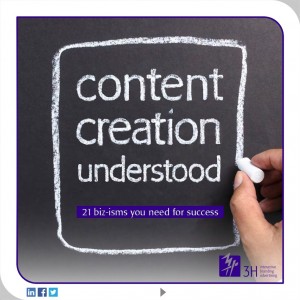
Being in marketing and practicing what we preach (yes we do walk the talk), we’re launching the latest title in our eBook series, Content Creation Understood: 21 biz-isms you need for success. It’s composed of short, snappy insights that will help you wrap your head around creating great content, in less than five minutes!
Coming Up!
Over the next few months, we’re going to follow up the eBook with blogs that expand on some of our biz-isms, so look out for those! Here’s a taste from the 21 ‘biz-isms’ in our eBook: #8 Content is only the first step, #16 Optimize your content.
Content Creation: Are We There Yet?, is a blog we published in May this year. If you think you’re not there yet, it’s the perfect time to download Content Creation Understood. If you think you are there, check it out anyway, there maybe something else you can do to drive your content farther!
Hope you enjoy it! Let us know what you think.
Twitter & Facebook: #ContentCreation #SocialMedia #SharedWisdom
by Miriam Hara | Aug 12, 2015 | Advertising, Agency, Business Success, Communications, Creative, Latest, Management, Marketing
Is the concept of ‘value add’ or ‘value added’ overused? Perhaps it’s more correct to ask, is it misused? Has ‘value added’ become like the tipping issue? Many of us tip automatically, whether it’s deserved or not. Has the term ‘value add’ become interchangeable with just doing a good job, or simply meeting expectations, not exceeding them? What happened to going above and beyond, every time that you can? To me, that’s value added.
The retail landscape is rife with ‘value adds’
The retail landscape is rife with ‘value adds’. Think about extended warranties. You purchase a new refrigerator. You wanted value for your money, so you likely paid for the brand name as well as the fridge’s features and benefits. Brands that have been around for a while, proved their worth, built a following, have intrinsic value. But as you’re buying that brand name fridge, the salesperson encourages you to purchase an extended warranty beyond the standard one-year warranty — a warranty that will protect you — and one you’ll have to pay for. Where’s the value in that?
What is that saying about the product? Shouldn’t you be able to expect that the refrigerator will work for you a heck of a lot longer than one year? And if it’s not going to, then shouldn’t the manufacturer promote an offer to fix anything that does go wrong in the 13th month after you bought it, and fix it for free. That would be a true value added proposition! Same thing goes for a car purchase and the extended warranties that go along with those purchases. Fundamentally, these types of things are not adding real value, they’re just up-selling and increasing the profitability of “you”. I believe I should be able to expect that most high-ticket items that I purchase are going to last a while; that they’re going to meet my expectation of performance, without me having to buy protection in case they don’t.
‘Value added’, from a business owner’s point of view, is having my vendors go beyond… which make them partners… not vendors.
‘Value added’, from my business owner point of view, is having my vendors go beyond. It’s having their service and their staff perform well beyond my expectations, not just meet my expectations. I hired them to meet my expectations. And I’m ecstatic when they exceed them! In other words… you got the business, now keep it by impressing.
In terms of my clients, value added doesn’t mean giving them great creative. They expect great creative. Why else do you go to an advertising agency? It doesn’t mean delivering on time, that’s an expectation from the outset. It doesn’t mean delivering results. That’s expected too.
‘Value added’ happens when we anticipate what the client needs before they need it.
Value added happens when we anticipate what the client needs before they need it. It’s when we nudge them by showing them there’s a better way. It’s by surprising them with things that they didn’t expect; things that help and delight them. Value added is exceeding beyond what our clients expect, and giving them a reason to keep coming back. It’s making them feel good about working with us because not only are we delivering on their expectation, we are adding value to the service and valuing them as clients, by exceeding their pre-conceived expectations. At its core, value added should be about building relationships.
Jump! How High? That’s not value added.
Jump! How high? That’s not value added. Leap as high as I can for my clients before they ask me to jump… now that’s adding value.
What is your idea of ‘value added’ in your ‘world’? I’d be interested to hear!
#ValueAdded #SharedWisdom #ExceedBeyond
by Miriam Hara | Aug 7, 2015 | Advertising, Branding, Business Success, Latest
The big ‘headline’ first made front page news during the 19th century newspaper wars when papers everywhere were fighting for readers’ attention. You’ve seen it in old movies — the kid on the street corner hawking the newspaper by yelling out the day’s headline! We’re still hawking with headlines. But are they effective? And do the old rules still apply? To be effective, your headlines need to be HOT!
If you don’t pull ’em in with the headline, anything else you write won’t matter.
Five times as many people read the headline as read the body copy. That was true years ago and it’s still true. No one reads the body copy and ignores the headline. If you don’t pull ’em in with the headline, anything else you write won’t matter. The medium doesn’t matter either: online or print — whether it’s advertising, journalism, a magazine article, Social Media via Facebook, LinkedIn, Twitter, etc. — the headline’s job never changes. Where the medium does matter is the sheer volume of headlines we’re exposed to via technology. To stand out, yours has to speak up louder and clearer than the street-corner kid. It must:
1. Grab attention.
2. Speak directly to the target audience.
3. Work as a complete message. Body copy is there only to flesh out the message.
A simple Google search hits the hot spots for a good headline
At its simplest, and strange as it might seem, a simple Google search hits the hot spots for a good headline. You want to know why your goldfish are dying in your backyard goldfish pond, so you type into the search engine: ‘Why are goldfish dying in my pond?’ It’s short, snappy, to the point. I’m not saying it’s a headline, but when agonizing over headlines, it helps to think of them in this way. My Google search about goldfish:
- Grabs attention: the attention of all websites on the subject.
- Speaks to a target audience: everyone who has something to say about dying goldfish (more on this below).
- Is a complete message: I want to know why my goldfish are dying.
I typed the goldfish question into Google and got 336,000 results — those results also illustrate the kind of competition we’re up against in advertising our brands today; thousands upon thousands of headlines with products, services or information vying for consumers’ attention. Now think about the search results; they work in much the same way as a headline.
A good search response, like a good headline, will reel me in and leave me happily fishing in a pond of information.
Results that are concise, descriptive and resonate with me, I’ll click on them. The ones that don’t, I’ll ignore: just like I’ll ignore a headline that doesn’t ‘move’ me. (An aside: all of this also illustrates the point of how important it is to get SEO right, so your website cuts through the clutter and rises to the top in search engine results.)
There’s a global glut of information out there and multiple mediums through which our advertising message can be delivered. So how do we cut through the clutter and get our message across in a way that’s hotter than everyone else’s with a similar product or service to sell? The old rules still apply …
- Make it short. How many words? you’re probably asking. “As many as needed,” David Ogilvy, the father of advertising, used to say. As many as needed is important: it doesn’t mean use a lot, it means exactly what it says: as many as needed to …
- Make it immediately compelling so that customers want to read more.
- Speak to the audience. Vitally important! A headline speaks to a target market, one you’ve researched thoroughly (hopefully!) before you ever start to think about headlines and body copy. It speaks to people who care about what you have to offer and that’s where your focus should be.
- Make sure your headline works with the visual(s). Think about ads you’ve seen. Look at a few critically after reading this. How often is the headline simply describing the visual? What a waste of space. If the visual is so weak you need to describe it, then you have a bigger issue.
- Understand catchy and clever! Sure, we remember catchy, clever headlines, but if we don’t remember the brand and what it’s selling, what’s the point?
- Humour can work, it can add personality, make a headline memorable, when used wisely and appropriately.
For small businesses without the backing of an agency skilled in creating great ad copy, it’s worth taking time to learn more about headlines, because dollars spent on advertising a truly great product using a truly ineffective headline are dollars wasted.
10 Sure-Fire Headline Formulas that work
100 Good Advertising Headlines
The Formula for a Perfect Headline
Best recent headline you’ve read? Send it to me! #SharedWisdom
by Miriam Hara | Aug 5, 2015 | Advertising, Communications, Creative, Latest
Peer to peer recognition is the most flattering of flattery. There is no greater compliment than those uttered by peers.
Being creative is not owned. Although not all people will agree with this, I believe it’s a talent that is given to each an everyone of us, although it is exercised in different ways. [inlinetweet prefix=”” tweeter=”” suffix=”#CreativeRespect”]I believe that problem solving is at the core of any creative process to find a solution.[/inlinetweet] That being said, a scientist, mathematician, physician, musician, artist, painter, writer and the list goes on, are all creative. The difference is the outside perception of what is deemed to be understandability creative.
In my world, all forms of communication interest me. Being naturally curious and in business, it is both my nature and business to view intently all ads, blogs, campaigns, contests, programs that I come across. I must say, with the advent of the internet, the exposure to creative talent, ideas, concepts, designs and campaigns is astounding. There are so many creative people in the world! More and more often, there are times, [inlinetweet prefix=”” tweeter=”” suffix=”#CreativeRespect”]upon viewing a design, ad or video, I say, “Wow…I wish I’d thought of that!”[/inlinetweet] Not in envy, but in real humble respect for the thought process that resulted in such a concept.
[inlinetweet prefix=”” tweeter=”” suffix=”#CreativeRespect”]What does it take to earn peer to peer respect in the creative world of advertising?[/inlinetweet]
When viewing this list, please think of ‘creative’ as a concept, a campaign, a TV spot, billboard, digital campaign, video, an ad…
- The creative must respect the brand: delivering on its promise and persona.
- The creative must uplift the brand on its shoulders, so to speak…elevating it rather than over-shadowing it.
- The creative must be emotive so that the brand emotionally connects with its intended target.
- The creative must deliver the message whether it’s rejuvenating a brand, inciting trial, or simply building awareness.
- The creative must be simple.
Here are a few examples of what I really think are powerful creatives that capture all of the above:
[inlinetweet prefix=”#CreativeRespect #SharedWisdom” tweeter=”” suffix=””]Do you have awesome creative that you would like to share with me? I would love to see! [/inlinetweet]#CreativeRespect #SharedWisdom
by Miriam Hara | Aug 4, 2015 | Advertising, Agency, Business Success, Deadline, Latest, Management, Marketing
Time is of the essence!
More than any other decade, business is running at the speed of light, which makes the efficient use of time ultimately the most important element to control. When I first entered the advertising business, the industry was notoriously known for its fast pace and deadlines. Contrary to corporate marketing departments, who albeit were also working at a faster pace than other departments in the same organization, advertising agencies owned the “RUSH” space. By owning that space, agency people often worked longer hours, weekends, evenings, around the clock to make an impending deadline. I can sincerely say, our industry no longer holds the monopoly on time. No matter what business you’re in today, time is of the essence!
All bets are off on personal time, downtime; any time is the time to work or check off one more item on the list of tasks to do and things to accomplish.
It goes without saying that the team around you, your colleagues, your support staff and every one in between plays a role in you efficiently managing your time and maintaining control over projects, launches and plans.
As a team member, or player or even potential wannabe team member, how does one add value to the department, the job, and ultimately the boss. Here’s a few of my thoughts:
1) When deadlines are looming and there just isn’t enough time, don’t tell me what you can’t do, tell me what you can do. Only then can a secondary plan of action emerge.
2) If there is an issue, and there are often issues with any project, don’t just come in and report the problem, without having all the facts. If the facts aren’t clear, you can’t work on a solution. Or better yet, come in with a solution – that would wow any manager.
3) Don’t say you can do something, then not; only to say you didn’t have the time. That only means you haven’t made the time. And that only means one of two things. 1) You felt it wasn’t important enough to get it off your list and 2) You didn’t plan or allot time to getting it done in a timely manner. Either way, it’s not good.
4) When tasks come your way, no matter how menial you perceive them to be, don’t just “do”. It’s the small things that shout the loudest in making impressions. So don’t just take direction, and do it; understand the need and ultimately the ‘why’ of what is being asked, so you can add value.
5) For all new business development managers, or client engagement managers, or any permutation thereof, if you’re successful in getting a meeting to present your organization’s services, don’t provide no more than what can be found on your website. That’s a waste of time, for both of us – and it’s also a missed opportunity.
And last but not least…
6) For all of you trying to break into any industry; don’t send in a resume for a job that you’re not qualified for. Wasting my time by having me read it only to find out that you’re not qualified for it – that only frustrates me. If you want to apply, then by all means do, but do something different; something that will provide me with a perspective of who and what you are about. Sending in a resume that you don’t have any qualifications for, without any explanation or counter claim, isn’t going to cut it – Honest.
