by Miriam Hara | Jun 12, 2015 | Business Success, Creative, Latest, Marketing
With the internet and social media opening up a new marketing dynamic, marketing function as it was is no longer valid – or is it? The business environment and the marketing function are continually evolving. What are the fundamental skills required of a marketing professional?
The digital landscape has created a convergence of many disciplines. Two of these are marketing function and creative skill. Gone are the days when there were distinct roles for designer, writer and creative director.
Recently, I received a comment on a post I wrote about the state of the creative environment. It stated that the “magic” of creative is now lost because of the “accessibility” of being creative for everyone. I realized the truth about that statement. The launch of great applications and software programs have enabled all of us to exercise the creative side of our personalities. That is truly wonderful! But does that mean that everyone has the potential of being a creative professional? I will go on the record as saying no, I don’t believe so.
Marketing function should take care of marketing – that’s what it should master.
Many feel that marketing function has changed. The expectation now is for marketing professionals to be able to “speak creative” and navigate through its “implementation” process. In the digital space, it is also expected that marketing professionals possess the ability to not only set content creation strategies, but also guide the content creation calendar, establish the critical path and even create content. All of that is a tall order for most marketing professionals. Not because they can’t do it, but considering the speed of business today, it’s simply too much to keep on top of in addition to existing marketing functions.
In the past, people within the marketing function simply needed to know enough about creative to understand its process and to make sure that the end campaign delivered on the objective, message, tone and ROI. However, it is no longer left to professionals and experts to provide the knowledge about how to “break through the clutter” in the “advertising” space. The lines are blurred. As a result, many initiatives are not as successful as they should be, resulting in the unfair assessment of the channel – traditional or digital. To put that into perspective, who hasn’t heard it said that Social Media is not garnering the expected ROI, and therefore isn’t a valuable channel? How many within a marketing function role have purchased media without going through a media strategist? How many in a marketing function role have built branded sites with an available CMS platform without understanding user experience or SEO? How many take on the role of directing creative, without having taken graphic design 101? Unfortunately, there are many more questions like these. And, I can only do one thing at a time. -sigh-
by Miriam Hara | Jun 8, 2015 | Business Success, Latest, Marketing, Social Media
Social media is here to stay. It’s a fact of life. Gone are the naysayers that insisted that it was a passing fad. Social networking is now the new business network and it’s thriving! Consider this: Facebook represents one of the biggest social networks connecting people to people, people to brands and business to business. Let’s not forget to mention Twitter, Instagram, Pinterest or LinkedIn, offering the same social networking possibilities. As of January 2015, the digital usage worldwide had increased exponentially.
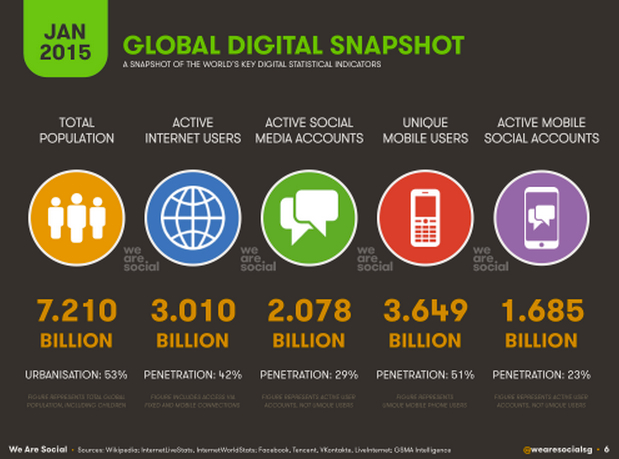
Source: Wearesocial.net
Social networking isn’t just about dressing for the part, it’s about ‘owning it’.
Over 2 billion people on the planet are active on social media. Individuals, brands and businesses should now recognize the increasing importance of social networking and getting found – at the right time and at the right place.
But it’s not just about being there and getting found. Having an active digital footprint is imperative. As such, the importance of a brand’s or business’ social media footprint needs follow suit. Not only do brands and businesses need to have a considerable social media footprint in order to participate and be relevant within the customer journey, they need to walk the talk, which means they need to own it.
Owning the social networking for your brand or business translates into the following:
Establishing the objectives for social networking: Like any business networking opportunity, you need to define your measurement of success before heading to the event. Is it to meet new people so they know your business, target a potential client or provide an avenue to secure a follow-up meeting?
Developing a cohesive content strategy: How are you going to introduce yourself? How are you going deliver what you want to say? It’s necessary to prepare your content with flexibility based on whom you are speaking to. Create a protocol for dealing with different scenarios – even the negative ones. These could involve possible ‘faux pas’ made on the brand’s behalf or a community member with a complaint and the inevitability of just dealing with rude people (they exist in the digital space as well as the physical space).
Knowing your audience: Don’t show up in jeans when everyone else is in a suit. It’s good to stand apart, but as a business or brand, the need to stand apart is very much tied into relevancy and perception. Building credibility on their terms is key.
Following up: If you are going to take the time to embrace social networking, you need to be responsive. There is no use reaching out if you’re not going to follow up. Establish a process with a set guidelines about when and how to respond. Be sure to also include guidelines for the tone and style of responses in order to maintain consistency.
Social networking is here to stay and it will become (if it isn’t already), a considerable venue to achieve business and brand targets. Control how your business or brand is perceived in this space by making sure that every aspect of the ‘meet’ is reviewed carefully. Dress appropriately, have confidence and walk the talk!
by Miriam Hara | Jun 1, 2015 | Business Success, Latest, Marketing
Corporate entrepreneurship is a philosophy whose time has come. In an age where speed is of the essence, the road to business success includes the ability to move quickly and accurately. In the universe of business, entrepreneurs as a segment have responded to that need. But what about corporate business entities?
What philosophies do corporations need to adopt in order to qualify as a corporate entrepreneurship?
Here are a few key qualities that are necessary for corporations to make the transition to corporate entrepreneurship.
Transparent Communications: Politics are death for any flourishing business. Management that allows their team to speak their mind, regardless of political correctness, is a good thing. When someone is more concerned about upsetting the “boss” by saying the wrong thing, all you have is a person filling a seat. The team members around the boardroom table that readily step up to the plate and speak their minds honestly are more dedicated and committed. They are looking only to improve business outcomes and should be valued for that. Think about it: Why else are they there? Hindering the openness in which views and ideas should be welcomed can only be met with delays, failure and loss of business. What’s more, by allowing your team to speak up, you empower them by letting them know their and opinions are valued.
Invest versus Spend: Often, innovative products are not properly supported because their launch budgets are perceived as spends and not investments. This leads to those products never reaching their full potential. If a product is worthy of being developed and manufactured, the premise should be that the market is there to sustain it over a period of time. When promoting or launching a product the question should be, “What will it take to carve out a significant position in the marketplace?” Many entrepreneurs launch their business by putting it all on the line and end up being are very, very successful. Products should be perceived in the same light.
Decisiveness. Being decisive is imperative in today’s market environment. In my marketing world, I always say: “Let’s put a stake in the sand.” Hand in hand with speed, decisiveness can springboard a business or brand to stardom. Although often, decisions are slow to happen (if any actually take place). By not having transparent communications (point #1), the result is a lack decision-making. A lack of decision-making results in a loss of opportunity.
Fluidity versus Perfection. Alas, perfection is not of this world – at least not for the business world. Too often, reworking a project until it’s 100% perfect means that 80% of the time and effort is spent achieving the additional 20% that will get it there. That’s usually the 20% no one notices. Understanding when to let go and when not to let go is key to success. Sometimes doing something is better than doing nothing. You can always perfect it as you go. But if you wait too long to get going, you could lose the opportunity and never get into a momentum.
More often than not, in today’s business environment, the philosophies behind corporate entrepreneurship are becoming necessary to survive the rate at which the speed of business is evolving. Do you have any other indicators that are key to business success today?
by Miriam Hara | May 29, 2015 | Business Success, Communications, Latest, Marketing, Social Media
Earned media isn’t new. It’s been around for a very long time, under the umbrella of PR. As with everything in marketing and communications, technology has widened the spectrum for PR to include much more than traditional, editorialized media. When it comes to earned media today, many relevant, niche blogs have opened up the traditional PR channel standbys of newspapers, magazines, e-magazines, broadcast and, yes, web sites.
Earned media has always been the coveted prize in marketing and branding. Suffice it to say, 92% of consumers say they trust earned media, such as word-of-mouth from friends, above all other forms of advertising.* That also isn’t new. What’s new is the accessibility to tap into this space. But it isn’t for the feint of heart!
Unlike traditional PR, social media has enabled the earned media channel to open up, allowing many businesses to establish themselves within this context.
No longer is the proverbial water cooler the only place people gather to talk about their experiences with products, their likes in advertising and their opinions. Social media properties; Facebook, Twitter, Instagram, Pinterest, Personal and niche blogs (to name only a fraction), are all out there providing thirsty information seekers with what they crave. They are reaching hundreds if not thousands of people who are listening and making buying decisions based on the information provided. According to inPowered and Nielsen, 85% of consumers regularly or occasionally seek out trusted expert content (credible, third-party articles, and reviews) when considering a purchase.
So what is required for business and brands to successfully harness this channel?
Let go: That is, let go of control! Understand that this communications environment cannot be controlled: Brand or business will not control the messaging, communities or influencers – consumers will.
Plan on it: Just because it’s social media and accessible, doesn’t mean that clear, concise objectives shouldn’t be established. Once objectives are set, create short and long-term strategies. Be sure to also create a content plan, editorial calendar, key communications topics and a concise SEO plan of action.
Be found creatively: One of the most important elements of earned media is to be interesting. Only content that resonates with your target audience will get shared. And of course all your creatively awesome content needs to be backed up with SEO. Whether it’s funny or useful, in written form, video or infographic; it must be shareworthy. But it doesn’t end there. Once it’s shareworthy, you need to make it easy to share!
It’s about time: Just because it’s free doesn’t mean it’s cheap. Earned media takes time to develop, initiate and nurture. We all know that time is at a premium. So before you embark in the earned media channel journey, know that both time and patience are required to garner results.
Be present: Yes, responsiveness and follow-up are key. This is not a one-way channel. It’s not just about putting the message out there. You also need to monitor it. You need to respond to comments, answer questions, offer opinions and reach out to influencers. There are many monitoring software programs out there to make that job easier but you really need to be present. It demonstrates that you care enough about your potential audience and what they have to say about your business. If done properly, over time this will garner the much coveted earned media result: Positivity towards your brand or business. It will have become worthy of chatting about, posting about and writing about over social media networks – ultimately developing grass roots brand ambassadors.
I hope this post was relevant and share worthy for you! You can subscribe to our blog here, follow us on Twitter, Facebook and LinkedIn. Or you can contact me. Share this post by clicking on the buttons found on the sidebar. Thanks in advance!
*Nielson Research Global consumers trust in earned advertising grows.
by Miriam Hara | May 13, 2015 | Agency, Business Success, Latest, Marketing, Social Media
Marketing has expanded and evolved due largely in part to the internet and the launch of what is now referred to as the social media channel. Social media was once all the buzz. Now it needs to step aside to allow for the new buzz: Content marketing. Content marketing is increasingly becoming all the buzz. It’s an integral part of social media. Content marketing is now ‘where it’s at’. Or is it?
As a content marketing agency, it’s a given that we are immersed in content creation and everything that goes along with it. Google now supports content marketing with its recent change to its algorithms (once again!) to include phrasing structures, incorporating them into the SEO keyword data metrics. This provides for optimal referencing and content creation to take place around a key thought. The possibilities with this are endless. Building a content marketing strategy around a topic is now a little easier, more authentic and dare I say more fluid! But the question begs to be asked: Are brands and businesses there yet?
First of all it’s important for businesses to understand what content marketing is. The digital footprint of businesses and brands needs to expand. 30% of adults (35-54) and 39% of adults (18-34) access their information digitally. Clearly there is a strong need for brands to be seen digitally. From a marketing perspective, the lines are continuously being blurred between traditional advertising and PR. New content marketing agencies are being launched with the aim of incorporating a blend of both. However, content marketing is much more than writing editorial or blogging. It’s larger than posting on Facebook or composing a Tweet within 140 characters. It also includes video content and streaming. Showing information is quickly becoming the norm. Many consumers are searching YouTube to learn how to build, create, make or bake! In Canada, YouTube hosts 80% of the online video consumed*. That’s significant, to say the least.
As any content marketing agency will tell you, you need to “work it”.
In other words, you need to spend the time, money and effort to make it happen. Many marketing and business professionals are mystified by content marketing and its affect on brand. That’s understandable. This is often tied into the illusion that content marketing can be handled internally. Like everything in marketing, content marketing needs to have a strategy. The strategy behind the content marketing, (preferably with the support of a content marketing agency), can and should be owned internally. Although, the development and “working” of content marketing, should be left to the experts.
There exists a need for a more integrated approach to social media to include content marketing for businesses, brands and branding. This includes everything from web design, SEO, eNewsletters, eBooks, eZines, subscriptions to blogs or forums to sales lead generation and marketing. All of it in the hope of “getting found” at the right place and at the right time.
So, are we there yet? Or more succinctly, are brands and businesses there yet?
by Miriam Hara | May 7, 2015 | Business Success, Latest, Marketing
I love Einstein – so much so that I have a sculpture of his face hanging on the wall in my office. Beyond his obvious legacy of scientific knowledge and forward thinking, I believe that he had a keen ability to zero in on the obvious about the human condition. Einstein’s observations (which I have interpreted as business insights), have helped me to make key business decisions many times. I believe he understood that common sense is not so common. He very eloquently provided perspective on the most common human habits and conditions. These perspectives are also key business insights that can be used on a daily basis.
Here’s the best of his business insight:
Einstein has been quoted many times for a variety of topics, many of which I have referred to in my day-to-day business life. My all time favourite is his definition of insanity: “Doing the same thing over and over again and expecting different results”. My team hears me quote this often.

If something doesn’t work, continuing to do it makes absolutely no sense. I challenge you to think about your business environment. I am sure you can identify processes, relationships or situations that no longer work yet are still are part of the structure. Whether it’s changing business relationships, developing product and marketing initiatives or creating a new dynamic – if something isn’t garnering the ROI required, it needs to change. However, it often doesn’t change. Why is that? How does that make business sense?
Here’s how you can adjust your perspective:
Be open to new ideas. If that sounds too “yogi” for you, just try being positive towards new ideas. In business, it’s so easy to say “no”. Why not give a new idea a chance? By that I mean, do your homework. Don’t say “It can’t be done”. Move away from that perspective. If you approach a new idea with “What if?”, any issue that may arise can be resolved more easily.
I have found in many business situations I’ve faced, this business insight has given me the courage needed to move forward and make calculated risks. It has allowed me to take leaps of faith in order to try things that haven’t been the norm in business. In business you must move forward. Doing the same old thing over again doesn’t make good business sense. Don’t be afraid to try something new. Take it from Einstein, if you keep approaching a situation or a problem in the same way, how can you expect a different outcome?
Are there any situations you’ve encountered in your business environment that could take a page out of Einstein’s business insights?