by Miriam Hara | Jun 26, 2015 | Branding, Communications, Latest, Social Media
When is too much, too much? Have we reached the over exposure point? Nowadays we get “news” (perhaps a better word is “info” since whether it’s all “news” is often debatable) from so many different sources. We see the same celebrity on TV, on magazine covers, on websites, in commercials, we get them tweeting, they post on Facebook. Often, it’s to the point of nausea … the celebrity has achieved over exposure. Malcolm Gladwell coined the phrase the ‘tipping point’ years ago and it stuck: “the moment when an idea, trend or behavior tips, and spreads like wildfire.” Over-exposure is like a tipping point gone wrong. Suddenly, things come to a head and everyone’s sick of hearing about that celebrity. When things reach this point, you actually get an outcome opposite to the desired reaction. Fans experiencing celebrity fatigue are turned off, tuning out any more news on that celebrity. They accuse the celebrity of chasing the “star light” (or hogging the limelight). Too much exposure is, in effect, too much.
The same is true for technology. We’re all (most of us) tech-savvy. Information is quite literally, always at our fingertips. Over stimulation leads to information fatigue, leading to an inability to process any more information. We live in an age of instant technological accessibility. I was reading a piece in the April/May 2015 issue of Marketing, written by Russ Martin. He was chatting to Michael Howatson, CD at Toronto’s Sapient Nitro about overstimulation. A couple of lines stood out for me: “Now that everything from toasters to cars is web-enabled, there’s a surplus of data being thrown at consumers who are already nearing their capacity for information.1” I was amazed to read: “Humans take in 27,000 times the info every day that a person in the 1500s would have.2” 27,000 times! No wonder we’re overwhelmed. The chatter is unending. In fact, where will it end? Imagine getting up in the morning and having your toaster speak to you! Don’t laugh, it’s closer than you think.
Never have we been so connected to so many people (and so many things!) at any given moment. Granted, there’s an upside, especially when it comes to keeping family connections vibrant, maintaining long distance relationships and ensuring business growth. But there’s a downside and it’s dramatic: the line that once defined work/life balance is becoming blurred … sometimes non-existent.
Yes, technology-enabled accessibility has had a considerable positive impact for businesses and brands trying to break through the clutter.
Reaching people and building rapport has never been easier. However, our customers’ minds are already taxed by the barrage of emails and text messages that pour into their business and personal lives daily. Now add to that the additional rivers of extraneous media chatter channeled through to them from all access points –radio, TV, our PC, phone, iPAD, tablet, even newspapers, books and magazines.
For business, the social media channel is accessible to all and that has made customer accessibility effortless. That being said, businesses and brands may still be using outdated “objectives” in this new world.
I agree with Howatson: As a business and a brand, “If what you’re doing doesn’t solve a problem or make your customers’ lives better, then don’t do it3”. I’d add: Don’t risk your business or brand becoming labelled a star-light chaser … splashed everywhere, but with no good reason.
If nothing else, I hope this post was helpful and insightful. Maybe it will resonate with you, perhaps start a conversation in your business, as the Marketing piece resonated with me. If your brand is a rising star, be wary of burn out. Heed the adage: too much of anything is never a good thing.
1,2,3 Quotes are from Marketing, page 26, April/May 2015; marketingmag.ca. Our apologies, for some reason, even with our subscription, we couldn’t pull up the link to pass it on.
by Miriam Hara | Jun 22, 2015 | Business Success, Latest, Social Media
Social media is not a single act … or a monologue. In order to achieve greatness (isn’t that what we’re all after!), a social media marketing strategy must embrace an internal social media culture. The use of social media must, and I repeat, must, be holistic.[inlinetweet prefix=”null” tweeter=”null” suffix=”#SocialMediaCulture”] We live in an age of voyeurism. [/inlinetweet] People want to know the ins and outs of brands and companies. They want to see for themselves the truth in everything. A properly developed social media marketing strategy takes advantage of a social media platform to educate, inform and to showcase what companies’ philosophies are all about, what their culture is all about.
A social media marketing strategy that promotes one tone and culture for their external audience and another for their internal audience is destined to meet with confusion and failure. You’ll be outed sooner than soon.
Recently, I was asked to take a survey giving my opinion on embracing an internal social media platform that would be like a social media intranet … allowing company departments to communicate with one another. I admit, I was and still am a little confused about this concept. I’ll tell you why.
Social media is all about being social, inclusive and holistic with everyone. To ring true, it’s a conversation that must run internally and externally. Our company’s social media is, I believe, inclusive. In any successful corporate or branded social media initiative, the entire company is on board. Social Media isn’t just marketing, nor is it customer service, or sales. It’s all of these and more, all departments singing from the same song sheet … yes, that includes the accounting department! In other words,[inlinetweet prefix=”null” tweeter=”null” suffix=”#SocialMediaCulture”] a business’s social media marketing strategy must incorporate all departments [/inlinetweet] and must make each department accountable for contributing to the overall social media initiative. That could take the form of staff or team members simply ‘liking’ a post, retweeting a comment, sharing an article, a post, or ‘how to’ video. All of these actions help fuel the integration of the business culture and business philosophy, leading to the success of the business’s social media platform, internally and externally.
As far as my opinion and receptiveness to an internal social media intranet, the concept just doesn’t ring true or right. If you’re doing it properly, your[inlinetweet prefix=”null” tweeter=”null” suffix=”#SocialMediaCulture”] Social Media should be a dimensional blend [/inlinetweet]; whether a business or brand, speaking to staff, clients and potential clients. Using social media as a platform allows you to speak to all of these segments. The use of LinkedIn Company pages, as with Facebook Brand pages, allows for communications between teams and followers alike. The actual channels may be different, but your tone, style, what you say, how you say it, the ways you choose to communicate should [inlinetweet prefix=”null” tweeter=”null” suffix=”#SocialMediaCulture”]remain true to your business and brand core[/inlinetweet]. A social media marketing strategy must always keep in mind that in today’s landscape, and that includes the internal corporate culture, people really are looking for the truth in things. If you live it inside the company, then outside the company it’s believable too: in other words, what is true, ultimately rings true.
by Miriam Hara | Jun 18, 2015 | Advertising, Business Success, Latest, Marketing, Social Media
As a skill, business writing isn’t new. Written expression has always been valued as a means of communication between departments within organizations. Few businesses can do without a key business writer.
Many feel a new dawn has arrived for business writing, making it more highly valued and sought after. With the advent of content marketing, businesses and corporations see strategic business writing as a skill they require from their marketing department. The hair-trigger reaction is to find someone to fulfill this important new “role”. But is this the most logical way to venture forward? In the brave new world of content marketing, what kind of writer does your business need?
Does the skill of business writing equal the skill of content creation?
The writing skill of a business writer may equal the writing skill of a content creator, but the skill sets are different. At the risk of sounding patronizing, not all writing “types” are the same. A journalist doesn’t write the same way as a novelist, or an editorial writer, or an investigative reporter, or a copywriter. Hence a business writer may not have the writing style or skill set needed for content marketing. Content marketing requires content creation, which requires not only basic business writing skills, but strategic and creative thinking. Those are the skills needed to propel content creation to the next level – getting the consumer interested and then engaged. A solid understanding and healthy respect for content development and creation is key to achieving content that resonates, eliciting the desired action from the consumer
Perhaps then, a content creator must be three parts writer and one part marketer: The writer must be investigative, inventive and devoted to engagement and the marketer ensures things relate back to brand, but not in an obvious way. It irks me when content is created under the guise of information, when in fact, it’s purely promotional. Shame on brand! Shame on business. Consumers today are savvy and they expect more from brands and businesses. Fortunately, in this new era, a good content creator understands and respects the difference. Businesses should too!
What are your thoughts on writing and on the new dynamic in the marketing landscape: Content marketing?
by Miriam Hara | Jun 15, 2015 | Advertising, Business Success, Latest, Social Media
“The advertising world is a young person’s game.” We have all heard this statement before – but is it accurate? Social media, although not in itself ‘advertising‘ has carved out its place within branding in an effort to establish brand relevancy. Similar to any other industry, advertising has evolved to include a ‘holistic‘ communication approach. Am I being naive by saying that there is indeed room for the 50+ marketer within social media – that we are not over the hill? Didn’t we also hear, “Today’s 50 is the new 40”?
It may come as a complete surprise to many that some people consider the 50+ executive to be over the hill. This kind of thinking ultimately leads to the conclusion that those over 50 should not be trying to navigate social media! Think about this: Did you know that the over the hill demographic is the fastest growing of Facebook users. More than half of all online adults 65 and older (56%) use Facebook. This represents 31% of all seniors. It would seem then that being over the hill, is about getting social! Forgive me, I digress.
My point is to speak about social media in the context of building a social media team. Has the business of social media taken on the same youthful persona as advertising? Is the perception of business and their corporate human resource management that the 50-something professional is over the hill and therefore not capable of embracing the new, fast-paced and ever-changing world of social media?
Here are a few reasons why any human resource manager should consider a 50-something applicant to be part of their social media team, (providing that they want to be part of a social media team):
They have people experience. They have business experience. They have process experience. They have team culture experience. They have life experience.
Couple this wealth of ‘experiences’ with these three core attributes that any candidate, regardless of age, needs to have:

Here’s another statement that we’ve all heard before that still rings true: “Don’t judge a book by its cover” – even if that cover is on your eReader screen. Tap open the book, swipe through the pages and you might be pleasantly surprised by what you learn.
by Miriam Hara | Jun 8, 2015 | Business Success, Latest, Marketing, Social Media
Social media is here to stay. It’s a fact of life. Gone are the naysayers that insisted that it was a passing fad. Social networking is now the new business network and it’s thriving! Consider this: Facebook represents one of the biggest social networks connecting people to people, people to brands and business to business. Let’s not forget to mention Twitter, Instagram, Pinterest or LinkedIn, offering the same social networking possibilities. As of January 2015, the digital usage worldwide had increased exponentially.
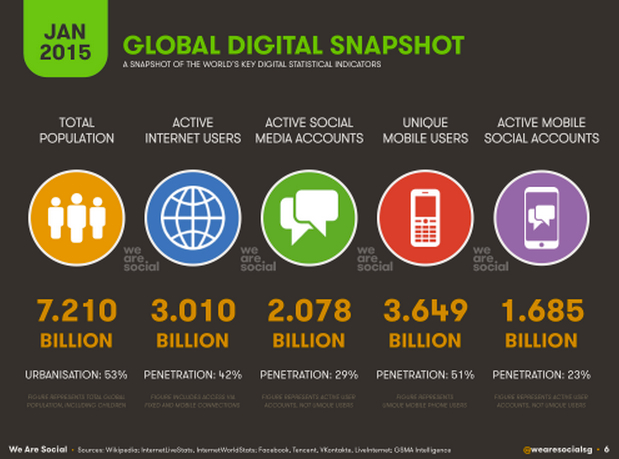
Source: Wearesocial.net
Social networking isn’t just about dressing for the part, it’s about ‘owning it’.
Over 2 billion people on the planet are active on social media. Individuals, brands and businesses should now recognize the increasing importance of social networking and getting found – at the right time and at the right place.
But it’s not just about being there and getting found. Having an active digital footprint is imperative. As such, the importance of a brand’s or business’ social media footprint needs follow suit. Not only do brands and businesses need to have a considerable social media footprint in order to participate and be relevant within the customer journey, they need to walk the talk, which means they need to own it.
Owning the social networking for your brand or business translates into the following:
Establishing the objectives for social networking: Like any business networking opportunity, you need to define your measurement of success before heading to the event. Is it to meet new people so they know your business, target a potential client or provide an avenue to secure a follow-up meeting?
Developing a cohesive content strategy: How are you going to introduce yourself? How are you going deliver what you want to say? It’s necessary to prepare your content with flexibility based on whom you are speaking to. Create a protocol for dealing with different scenarios – even the negative ones. These could involve possible ‘faux pas’ made on the brand’s behalf or a community member with a complaint and the inevitability of just dealing with rude people (they exist in the digital space as well as the physical space).
Knowing your audience: Don’t show up in jeans when everyone else is in a suit. It’s good to stand apart, but as a business or brand, the need to stand apart is very much tied into relevancy and perception. Building credibility on their terms is key.
Following up: If you are going to take the time to embrace social networking, you need to be responsive. There is no use reaching out if you’re not going to follow up. Establish a process with a set guidelines about when and how to respond. Be sure to also include guidelines for the tone and style of responses in order to maintain consistency.
Social networking is here to stay and it will become (if it isn’t already), a considerable venue to achieve business and brand targets. Control how your business or brand is perceived in this space by making sure that every aspect of the ‘meet’ is reviewed carefully. Dress appropriately, have confidence and walk the talk!
by Miriam Hara | Jun 5, 2015 | Business Success, Communications, Latest, Social Media
In a world of anonymity, courtesy of all the social media channels we have, it’s increasingly easier to develop a ‘sub-persona’ (digital persona) of the real ‘you’. Social media engagement has given everyone a voice for their opinions – the good, the bad and the ugly! There’s nothing inherently wrong with engagement. It’s actually very good. How we engage is the issue.
To add value and credibility to opinions, don’t you need to stand by them? In order to stand by them, you need to ‘own it’ and not hide behind a social media digital persona that is not reflective of who you truly are.
I am sure I am not the only one who has cringed at a response to a comment or has been appalled at the lack of respect shown for differences of opinion. Social media has already evolved into a viable channel and information stream. This will continue as it enters its next phase of maturity. We are all part of a global community comprising of a mishmash of cultures and societal differences. It has become increasingly important for each one of us to implement a code of conduct for our social media engagement. This begs the question: What would that social media engagement code of conduct consist of? I am reminded of the social rules my mom taught me growing up – with a slightly digital twist!
Here are a few ‘Mom’ social media engagement takeaways:
Be helpful. The social media channel has allowed all of us to be part of a larger community – a global community. There are no borders or boundaries. As such, we have opened ourselves to different people’s perspectives and experiences. If someone needs help from LinkedIn, a Group Post or Facebook and you can offer expertise, an opinion or an alternate point of view, do it – not to sell, but to assist. Pay it forward. Like everything else in life, it’ll come back to you!
If you don’t have anything nice say… The last part of this rule of social engagement is ’don’t say anything at all’. But in the digital space, if you’re not saying something nice, at least be positive and constructive in how you say it. Or go back to Mom’s rule and don’t say anything at all – just click away!
The only thing you can control is your own behaviour. Not everyone is going to like you, want to be your friend or even have the same values as you. That’s true no matter what space you engage in. Understand this and respond to negativity with kindness. If you can’t do that, then disengage. There’s no need to add undue stress to your life. You are not going to change anyone. You have choices, exercise them.
Be mindful. Think about the subjects you discuss and how you discuss them. The immediacy of social media makes it easy to jump right in and text/post/comment the first thing that pops into your head. Although, it’s not conducive or good conduct to just blurt out whatever you have on your mind.
A Social media engagement code of conduct is important for governing how we interact on a digital personal or digital business level. It’s important to gain control of your access and how you are being perceived. Mom’s rules of social conduct for face-to-face interactions really makes senses for social media engagement conduct as well. What do you think?