by Miriam Hara | Jun 15, 2015 | Advertising, Business Success, Latest, Social Media
“The advertising world is a young person’s game.” We have all heard this statement before – but is it accurate? Social media, although not in itself ‘advertising‘ has carved out its place within branding in an effort to establish brand relevancy. Similar to any other industry, advertising has evolved to include a ‘holistic‘ communication approach. Am I being naive by saying that there is indeed room for the 50+ marketer within social media – that we are not over the hill? Didn’t we also hear, “Today’s 50 is the new 40”?
It may come as a complete surprise to many that some people consider the 50+ executive to be over the hill. This kind of thinking ultimately leads to the conclusion that those over 50 should not be trying to navigate social media! Think about this: Did you know that the over the hill demographic is the fastest growing of Facebook users. More than half of all online adults 65 and older (56%) use Facebook. This represents 31% of all seniors. It would seem then that being over the hill, is about getting social! Forgive me, I digress.
My point is to speak about social media in the context of building a social media team. Has the business of social media taken on the same youthful persona as advertising? Is the perception of business and their corporate human resource management that the 50-something professional is over the hill and therefore not capable of embracing the new, fast-paced and ever-changing world of social media?
Here are a few reasons why any human resource manager should consider a 50-something applicant to be part of their social media team, (providing that they want to be part of a social media team):
They have people experience. They have business experience. They have process experience. They have team culture experience. They have life experience.
Couple this wealth of ‘experiences’ with these three core attributes that any candidate, regardless of age, needs to have:

Here’s another statement that we’ve all heard before that still rings true: “Don’t judge a book by its cover” – even if that cover is on your eReader screen. Tap open the book, swipe through the pages and you might be pleasantly surprised by what you learn.
by Miriam Hara | Jun 12, 2015 | Business Success, Creative, Latest, Marketing
With the internet and social media opening up a new marketing dynamic, marketing function as it was is no longer valid – or is it? The business environment and the marketing function are continually evolving. What are the fundamental skills required of a marketing professional?
The digital landscape has created a convergence of many disciplines. Two of these are marketing function and creative skill. Gone are the days when there were distinct roles for designer, writer and creative director.
Recently, I received a comment on a post I wrote about the state of the creative environment. It stated that the “magic” of creative is now lost because of the “accessibility” of being creative for everyone. I realized the truth about that statement. The launch of great applications and software programs have enabled all of us to exercise the creative side of our personalities. That is truly wonderful! But does that mean that everyone has the potential of being a creative professional? I will go on the record as saying no, I don’t believe so.
Marketing function should take care of marketing – that’s what it should master.
Many feel that marketing function has changed. The expectation now is for marketing professionals to be able to “speak creative” and navigate through its “implementation” process. In the digital space, it is also expected that marketing professionals possess the ability to not only set content creation strategies, but also guide the content creation calendar, establish the critical path and even create content. All of that is a tall order for most marketing professionals. Not because they can’t do it, but considering the speed of business today, it’s simply too much to keep on top of in addition to existing marketing functions.
In the past, people within the marketing function simply needed to know enough about creative to understand its process and to make sure that the end campaign delivered on the objective, message, tone and ROI. However, it is no longer left to professionals and experts to provide the knowledge about how to “break through the clutter” in the “advertising” space. The lines are blurred. As a result, many initiatives are not as successful as they should be, resulting in the unfair assessment of the channel – traditional or digital. To put that into perspective, who hasn’t heard it said that Social Media is not garnering the expected ROI, and therefore isn’t a valuable channel? How many within a marketing function role have purchased media without going through a media strategist? How many in a marketing function role have built branded sites with an available CMS platform without understanding user experience or SEO? How many take on the role of directing creative, without having taken graphic design 101? Unfortunately, there are many more questions like these. And, I can only do one thing at a time. -sigh-
by Miriam Hara | Jun 8, 2015 | Business Success, Latest, Marketing, Social Media
Social media is here to stay. It’s a fact of life. Gone are the naysayers that insisted that it was a passing fad. Social networking is now the new business network and it’s thriving! Consider this: Facebook represents one of the biggest social networks connecting people to people, people to brands and business to business. Let’s not forget to mention Twitter, Instagram, Pinterest or LinkedIn, offering the same social networking possibilities. As of January 2015, the digital usage worldwide had increased exponentially.
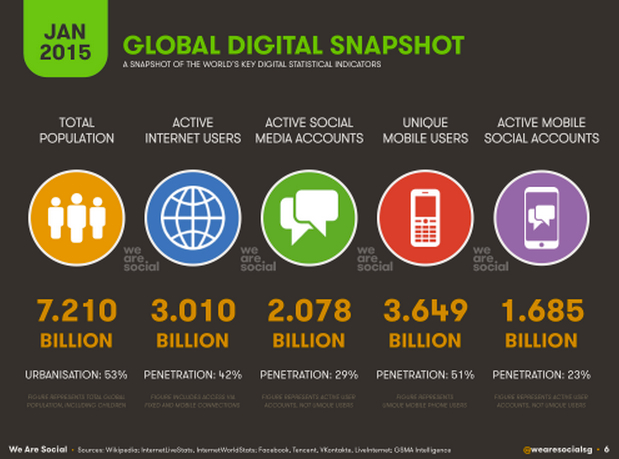
Source: Wearesocial.net
Social networking isn’t just about dressing for the part, it’s about ‘owning it’.
Over 2 billion people on the planet are active on social media. Individuals, brands and businesses should now recognize the increasing importance of social networking and getting found – at the right time and at the right place.
But it’s not just about being there and getting found. Having an active digital footprint is imperative. As such, the importance of a brand’s or business’ social media footprint needs follow suit. Not only do brands and businesses need to have a considerable social media footprint in order to participate and be relevant within the customer journey, they need to walk the talk, which means they need to own it.
Owning the social networking for your brand or business translates into the following:
Establishing the objectives for social networking: Like any business networking opportunity, you need to define your measurement of success before heading to the event. Is it to meet new people so they know your business, target a potential client or provide an avenue to secure a follow-up meeting?
Developing a cohesive content strategy: How are you going to introduce yourself? How are you going deliver what you want to say? It’s necessary to prepare your content with flexibility based on whom you are speaking to. Create a protocol for dealing with different scenarios – even the negative ones. These could involve possible ‘faux pas’ made on the brand’s behalf or a community member with a complaint and the inevitability of just dealing with rude people (they exist in the digital space as well as the physical space).
Knowing your audience: Don’t show up in jeans when everyone else is in a suit. It’s good to stand apart, but as a business or brand, the need to stand apart is very much tied into relevancy and perception. Building credibility on their terms is key.
Following up: If you are going to take the time to embrace social networking, you need to be responsive. There is no use reaching out if you’re not going to follow up. Establish a process with a set guidelines about when and how to respond. Be sure to also include guidelines for the tone and style of responses in order to maintain consistency.
Social networking is here to stay and it will become (if it isn’t already), a considerable venue to achieve business and brand targets. Control how your business or brand is perceived in this space by making sure that every aspect of the ‘meet’ is reviewed carefully. Dress appropriately, have confidence and walk the talk!
by Miriam Hara | Jun 5, 2015 | Business Success, Communications, Latest, Social Media
In a world of anonymity, courtesy of all the social media channels we have, it’s increasingly easier to develop a ‘sub-persona’ (digital persona) of the real ‘you’. Social media engagement has given everyone a voice for their opinions – the good, the bad and the ugly! There’s nothing inherently wrong with engagement. It’s actually very good. How we engage is the issue.
To add value and credibility to opinions, don’t you need to stand by them? In order to stand by them, you need to ‘own it’ and not hide behind a social media digital persona that is not reflective of who you truly are.
I am sure I am not the only one who has cringed at a response to a comment or has been appalled at the lack of respect shown for differences of opinion. Social media has already evolved into a viable channel and information stream. This will continue as it enters its next phase of maturity. We are all part of a global community comprising of a mishmash of cultures and societal differences. It has become increasingly important for each one of us to implement a code of conduct for our social media engagement. This begs the question: What would that social media engagement code of conduct consist of? I am reminded of the social rules my mom taught me growing up – with a slightly digital twist!
Here are a few ‘Mom’ social media engagement takeaways:
Be helpful. The social media channel has allowed all of us to be part of a larger community – a global community. There are no borders or boundaries. As such, we have opened ourselves to different people’s perspectives and experiences. If someone needs help from LinkedIn, a Group Post or Facebook and you can offer expertise, an opinion or an alternate point of view, do it – not to sell, but to assist. Pay it forward. Like everything else in life, it’ll come back to you!
If you don’t have anything nice say… The last part of this rule of social engagement is ’don’t say anything at all’. But in the digital space, if you’re not saying something nice, at least be positive and constructive in how you say it. Or go back to Mom’s rule and don’t say anything at all – just click away!
The only thing you can control is your own behaviour. Not everyone is going to like you, want to be your friend or even have the same values as you. That’s true no matter what space you engage in. Understand this and respond to negativity with kindness. If you can’t do that, then disengage. There’s no need to add undue stress to your life. You are not going to change anyone. You have choices, exercise them.
Be mindful. Think about the subjects you discuss and how you discuss them. The immediacy of social media makes it easy to jump right in and text/post/comment the first thing that pops into your head. Although, it’s not conducive or good conduct to just blurt out whatever you have on your mind.
A Social media engagement code of conduct is important for governing how we interact on a digital personal or digital business level. It’s important to gain control of your access and how you are being perceived. Mom’s rules of social conduct for face-to-face interactions really makes senses for social media engagement conduct as well. What do you think?
by Miriam Hara | Jun 3, 2015 | Business Success, Latest, Uncategorized
Led Zeppelin had it right – ‘All that glitters is not gold’. More profound words were never spoken.
The digital revolution has occurred over the last three decades. Since then, businesses and brands have rushed in (some more than others), to jump on the band wagon and be part of the curve. Well, it’s time to take a breather. Business managers and those that lead brand marketing need to stop and evaluate their part in it. Just because it’s there, doesn’t mean you or your brand have to be there.
Newsflash: We are now entering the digital evolution phase of the digital revolution.
Digital technology has propelled business forward. Now, it’s time to take stock and assess. Over the last few decades, we have all ventured into new areas and channels. As business leaders, we’ve taken the proverbial plunge. Some were hits, others were not. And there were times when we hit the bottom hard. Have we learned anything from that experience?
To paraphrase Led Zeppelin’s Stairway to Heaven verse: All that is new isn’t necessarily the best. Yet the minute we hear about something new, we rush in – trying to conquer and assess all at the same time. Sometimes that works and sometimes it doesn’t. It’s time that we stop to investigate the real value of what we are doing and who we are entrusting our business and brands to.
As we open up our email tomorrow morning, chances are that we’ll be bombarded with messages that all shout as loud as possible. Out with the old and in with the new. Just remember this: Breathe. The digital revolution is upon us and we must adapt. We must embark and conform. But can we just pause for a moment? The speed of the digital space has made businesses react, rather than plan. Just because it’s there, doesn’t mean you or your brand have to be there this instant.
For marketing and business alike, many digital services and products speak about brand being part of the experience – a living organism. Here’s another newsflash: Brand marketing, if it was ever done properly prior to the digital revolution, has always been about more than just a name or brand awareness. For consumers to live the brand, the marketing and brand pillars that make a product into a ‘household’ brand still apply. The only things that have changed are the channels available and potential access points.
The new way of doing things will still be there tomorrow. Such is the future. If anything changes, taking the time to assess and do it right might have been a good strategy after all.
by Miriam Hara | Jun 1, 2015 | Business Success, Latest, Marketing
Corporate entrepreneurship is a philosophy whose time has come. In an age where speed is of the essence, the road to business success includes the ability to move quickly and accurately. In the universe of business, entrepreneurs as a segment have responded to that need. But what about corporate business entities?
What philosophies do corporations need to adopt in order to qualify as a corporate entrepreneurship?
Here are a few key qualities that are necessary for corporations to make the transition to corporate entrepreneurship.
Transparent Communications: Politics are death for any flourishing business. Management that allows their team to speak their mind, regardless of political correctness, is a good thing. When someone is more concerned about upsetting the “boss” by saying the wrong thing, all you have is a person filling a seat. The team members around the boardroom table that readily step up to the plate and speak their minds honestly are more dedicated and committed. They are looking only to improve business outcomes and should be valued for that. Think about it: Why else are they there? Hindering the openness in which views and ideas should be welcomed can only be met with delays, failure and loss of business. What’s more, by allowing your team to speak up, you empower them by letting them know their and opinions are valued.
Invest versus Spend: Often, innovative products are not properly supported because their launch budgets are perceived as spends and not investments. This leads to those products never reaching their full potential. If a product is worthy of being developed and manufactured, the premise should be that the market is there to sustain it over a period of time. When promoting or launching a product the question should be, “What will it take to carve out a significant position in the marketplace?” Many entrepreneurs launch their business by putting it all on the line and end up being are very, very successful. Products should be perceived in the same light.
Decisiveness. Being decisive is imperative in today’s market environment. In my marketing world, I always say: “Let’s put a stake in the sand.” Hand in hand with speed, decisiveness can springboard a business or brand to stardom. Although often, decisions are slow to happen (if any actually take place). By not having transparent communications (point #1), the result is a lack decision-making. A lack of decision-making results in a loss of opportunity.
Fluidity versus Perfection. Alas, perfection is not of this world – at least not for the business world. Too often, reworking a project until it’s 100% perfect means that 80% of the time and effort is spent achieving the additional 20% that will get it there. That’s usually the 20% no one notices. Understanding when to let go and when not to let go is key to success. Sometimes doing something is better than doing nothing. You can always perfect it as you go. But if you wait too long to get going, you could lose the opportunity and never get into a momentum.
More often than not, in today’s business environment, the philosophies behind corporate entrepreneurship are becoming necessary to survive the rate at which the speed of business is evolving. Do you have any other indicators that are key to business success today?